Occupy’s Radicalism Prompts Disdain from Liberal Class
After holding so-called ‘progressive’ Democrats accountable, Occupy Chicago gets a telling-off from media and aldermen.
Joe Macaré
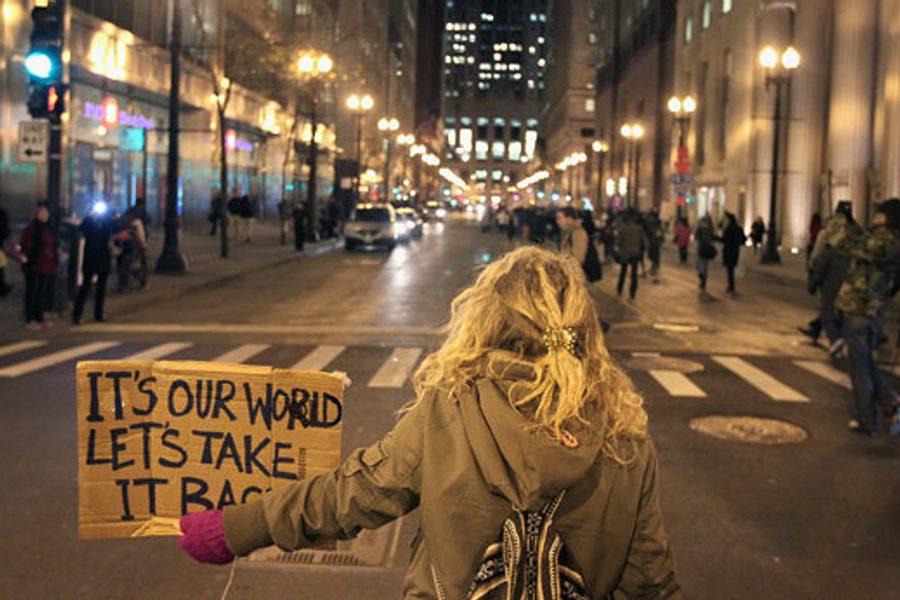
“Acts of resistance are moral acts…. They should be carried out not because they are effective, but because they are right. Those who begin these acts are always few. They are dismissed by those in the liberal class, who hide their cowardice behind their cynicism.” - Chris Hedges, Death of the Liberal Class
Death of the Liberal Class is not a perfect book – Chris Hedges’ love for the classical and puritan tendencies mar the discussions of art and the internet, and I’m not sure what place there is for, say, sex or atheism in his revolution – but it is something of a must-read for anyone seeking to understand the Occupy movement.
Not because Hedges is one of those elusive leaders who, pundits keep telling us, must surely exist somewhere, but because of how presciently the book examines both the circumstances that made Occupy Wall Street necessary, perhaps almost inevitable, and the moral, political and intellectual bankruptcy of the reaction to the movement from many members of the “liberal class,” defined by Hedges as including the media, the Democratic Party, the labor movement, the church, the arts and universities.
In Chicago, reaction from the first two groups has been brought into focus recently by a group of Occupy Chicago participants’ decision to “mic check” Alderman Joe Moore, after the Chicago City Council’s unaminous 50-0 vote approved Mayor Rahm Emanuel’s 2012 Budget. This prompted a scathing response from NBC Chicago’s Edward McClelland:
If the Occupy Chicago movement is looking to validate Newt Gingrich’s admonition to “take a bath and get a job,” or Joe Walsh’s dismissal of its members as “spoiled, pampered, unfocused clueless young people,” it took a good step Monday night, by “mic checking” the 49th Ward Democratic Party meeting, while Ald. Joe Moore was speaking.
The reasoning here, if you can call it that, is pretty clear and striking: The Occupy movement is a wonderful outpouring of grassroots activism right up to the point at which it starts to hold Democrats, supposedly progressive Democrats no less, accountable. At that point, every single right-wing smear of the movement becomes magically valid, and all the protesters suddenly start smelling.
Perhaps the most telling response comes not from a journalist, but from “my” very own Alderman, Proco “Joe” Moreno. In the Huffington Post, Moreno picks up an argument from McClelland’s blog post and runs with it:
This kind of civil disobedience is likely to further entrench and enlarge a dislike for Occupy that I’m starting to sense and don’t want to see.
A working class backlash against Occupy would be ruinous for the movement and for the country. An entire generation of Reagan Democrats was created by the Anti-Vietnam War movement, which often went too far and looked too hard for moral purity when, in reality, there’s no such thing.
This is pretty amoral, ahistorical stuff. It’s hard to know where to start, even if we decide to take on trust that the “dislike for Occupy” Moreno has been “starting to sense” has some kind of basis in empirically observed reality (as opposed to just being something in the Wicker Park air he picked up using his special Hipster Alderman superpowers). But let’s break this down into four key fallacies:
1. The Moral Fallacy. The dichotomy Moreno sets up is between an uncompromising, unrealistic moral purity on the one hand, and a pragmatic, get-things-done attitude on the other. He did the same thing in his explanation of why he voted for Emanuel’s budget in the first place: “I voted yes today because it’s my responsibility to make tough decisions. We’re going to have to grit our teeth and persevere.” And he’s made similar comments on Twitter: “Seeking moral purity will always lead to disappointment,” he wrote in response to a piece by In These Times contributing editor Achy Obejas, and before dismissing another dissenter with “or just be an absolutist if that makes you feel good.”
The problem is that, even aside from the powerful argument against utilitarianism made by Chris Hedges, this is very familiar rhetoric. It’s rhetoric that has been used extensively by the political class as they implement austerity policies (which is what Emanuel’s budget is): These are tough decisions, but they are necessary, and so in fact their unpalatable nature makes it even more admirable that “progressive” politicians make them.
That’s clever, effective spin, which is to say it’s also disingenuous hokum. It’s actually much more difficult to adhere to a moral position than it is to compromise it for personal and professional ease, and in few places is this more true than modern American politics. Compromise the needs and wants of your constitutents to stay in the good graces of your party, and the mainstream media will laud you: Take a stand, and you will be pushed to the margins.
And in the specific case of austerity policies, this is even more of a fallacy: We have to find somewhere to make these tough cuts, we are told, because there is no money. None. Not a cent. The cupboard is bare. We are told this by our millionaire mayor, while he holds court with his fellow millionaires and supports state tax breaks for wealthy corporate interests (rejected yesterday by the Illinois House).
It’s no wonder that people are able to see through this, and those Occupy Chicago members who mic checked Alderman Moore expressed a clear-eyed understanding of the charade: “We are not interested in excuses or explanations. It’s a song we’ve heard before,” they announced. “Every time cuts like these are made, we are assured that more can be done with less.”
2. The Tactical Fallacy. “I don’t think mic checking Ald. Moore (or any other Alderman) because he voted for the city budget is a good tactic,” says Moreno.
To which the only real response is, well, he would say that, wouldn’t he? It’s hard not to read this as a plea to Occupy Chicago to keep the people’s mic away from Moreno’s own events. But if he really wants to engage with them, he can go to a General Assembly and explain how exactly voting for the budget is some kind of genius Machiavellian chessmaster tactic, and holding accountable politicians who voted for the budget is a no-no.
Part of the rhetorical sleight of hand here is the idea that Moore and Moreno are valuable allies that Occupy Chicago is in danger of losing. But this is backwards: Being an ally to or supportive any movement involves a level of responsibility specifically related to any position of power you may hold. Since Occupy Chicago made their feelings on Emanuel’s proposed budget pretty clear in advance, the City Council vote was one of the first real tests of any potential allies on the council. One day after voting yes, Moreno was still retweeting Occupy Chicago calls for hot coffee donations: A nice gesture, if he hadn’t had the opportunity to do something significantly more substantial as an ally, and failed.
The most charitable explanation here is that Moreno honestly believes that Emanuel will reward the Council for their fealty by pursuing policies in future that are more in keeping with the interests they claim to represent, including those of Occupy Chicago members. To say this is a stretch is putting it mildly. Even before President Obama’s administration set new records in concession-making, with dismal results, as a British citizen I had watched this tactical approach in action since 2001: As Prime Minister Tony Blair pledged to do just about anything George W. Bush wanted with regard to the “War on Terror,” the liberal class wisely concluded that this would enable the supposedly less imperialistic junior partner to win either strategic rewards for the country or even persuade Bush to chart a less unilateral, less aggressive course. It did neither.
Single-minded, strong-willed people in power do not respond to concessions and obedience by deviating from their plans, as a rule. They respond by claiming they have a mandate. But maybe I’m wrong about this mayor. Maybe Rahm “fuck the UAW” Emanuel isn’t gearing up for more unionbusting. Maybe Rahm “fucking retarded” Emanuel is going to listen to progressives now. Rahm “The job of everyone in this room is to move the President to a solution that works” Emanuel. Sure. That seems likely.
3. The Historical Fallacy. You could write a book on this one, except I’m pretty sure several already exist. I don’t know where this idea comes from that Reagan, perhaps even the rightward drift of American politics over the past 30-40 years, can be blamed on protesters against the Vietnam War - but it sounds like it came from hearing someone else who hadn’t read Nixonland describe it in a bar. Or perhaps, more accurately, it comes from decades in which those who opposed the war have been smeared with fabrications: They spat on returning veterans, you know!
Over Thanksgiving one of my partner’s family, a former Ford plant worker from the Detroit area, displayed more support for and understanding of the Occupy movement than the politicians and pundits who are supposedly – and on some issues, unequivocally – far more “progressive” than he is. [This seems like a good place for the required full disclosure that my partner is an Occupy Chicago committee member.] Not coincidentally, he also had a different take on the Vietnam War protests, one born of being drafted into the military during the war and having friends who were sent over to fight and die pointlessly in the name of American imperialism.
Describing a conversation he’d had with friends unconvinced by Occupy, he said, “I told them, you remember Vietnam? It took people protesting on the streets to get us out of there.” But he added that his generation “blew it… We stopped the Vietnam War, but we didn’t go far enough in reigning the government in.” If only Alderman Moreno and Ted McClelland had been there to explain that the Vietnam protesters went too far, rather than not going far enough.
Here’s the other thing about the Anti-Vietnam War movement: Its goal wasn’t to ensure that Democrats were elected in perpetuity. Its goal was, oddly enough, to end the Vietnam War (started under a Democratic president, ended under a Republican). It succeeded, eventually – but only after years of toiling away being ignored or actively reviled by the liberal class, many of whom thought that those who objected to the war shouldn’t dare reproach that nice progressive LBJ. Sound familiar?
4. The Occupy Fallacy. By the same token, the goal of the Occupy movement is not to ensure Democrats do well in 2012 or any other election. While the movement is broad and each local iteration has its own characteristics, and indeed differences of opinion within it, one thing is consistent: Occupiers see the struggle to get money out of politics and resist the dominance of corporate power as more important than party politics. I am not leaking some secret truth or imposing my own agenda when I say this. It’s Occupy 101: In Chicago, for example, the disclaimer that this is a non-partisan movement is said at the beginning of every single General Assembly.
But working to elect Democrats is the only goal the liberal class has understood in America for decades. So expect the increasing number of finger-wagging articles from liberal commentators and quote-unquote progressive politicians to grow exponentially as the 2012 election approaches if the Occupy movement continues to hold Democrats accountable as well as Republicans – as it surely must.
Time to pick a side.

Get 10 print issues of our award-winning, worker-first journalism here!