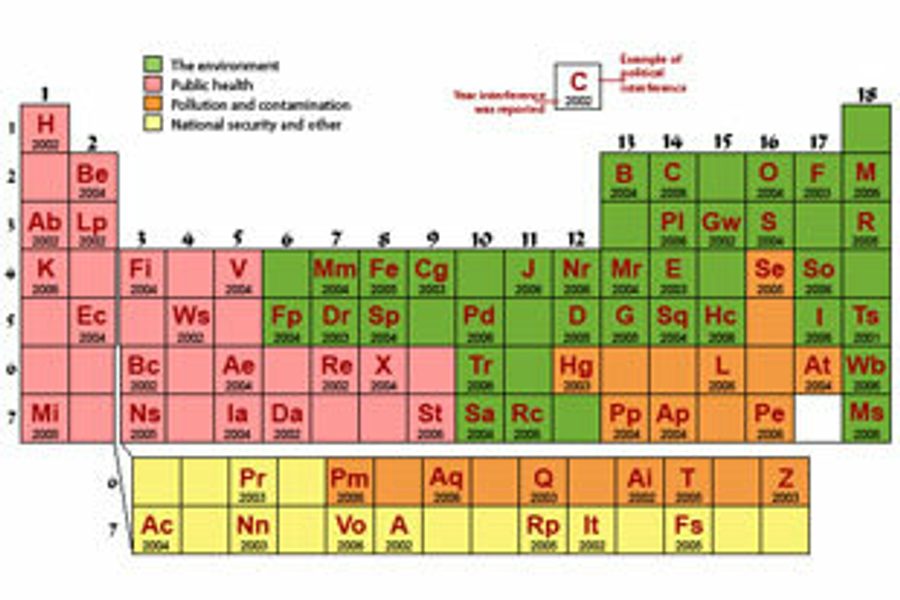

Sound science counts itself as one of the many victims of the Bush administration’s assault on reason, and sound science is fighting back – finally, with support from Congress. Sen. Daniel Inouye (D-Hawaii), chairman of the Senate Committee on Commerce, Science and Transportation held a hearing on Feb. 7 to explore allegations that the government has attempted to censor 150 climate scientists by pressuring them to delete references to “global warming” or “climate change” from scientific papers and reports, and avoid talking with the media.
One of the driving forces behind Inouye’s hearing was a petition signed by more than 10,000 scientists this past December, decrying administration attempts to politicize science. The Union of Concerned Scientists (UCS) circulated that petition along with an “A to Z Guide to Political Interference in Science” that documents hundreds of instances of censorship and political interference. Signatories include 52 Nobel Laureates, 63 National Medal of Science recipients and almost 200 members of the National Academies of Science.
At the same time it has gagged scientists who warned of climate change, the Bush administration has amplified voices of “experts” from the oil and gas industry. Philip A. Cooney worked as a lawyer for the American Petroleum Institute before being ushered into the White House’s Council on Environmental Quality. Following accusations in 2005 that he edited government reports to raise doubts about global warming and downplay the findings of mainstream scientists, Cooney left the White House for a job with ExxonMobil Corp.
Tampering with science didn’t begin with Bush. Under the leadership of Newt Gingrich, in 1995 the Republican-controlled Congress withdrew funding for the Office of Technology Assessment, which since 1972 had provided reliable scientific counsel.
Before that, the work of NASA scientist, and one of the first whistleblowers about global warming, James Hansen was censored by the first Bush administration. Last year Hansen accused NASA administrators of trying to influence his public statements about the causes of climate change.
“The scientist statement makes clear that while science is rarely the only factor in public policy decisions, this input should be objective and impartial,” says Francesca Grifo, the director of the UCS’s Scientific Integrity Program. “Sustained protest from scientists, individual Republicans and Democrats in Congress, and the nation’s leading editorial pages has not been enough to make the abuse of science stop.”
The UCS presented its “A to Z Guide” in the form of a mock Periodic Table of Elements with a different color to represent each subject. The violations of scientific integrity date back to 2002, and range from “Abstinence Only Sex Education Science” to “Ground Zero,” from “Arms Control Advisory Panel” to “School Vouchers.”
Some issues are more political than scientific – like the Department of Justice’s suppression of a racial profiling study in August 2005 – while others focus on issues of health and safety. The guide reports that in October 2002 “nominees selected by the staff of scientists” were rejected from the Childhood Lead Poisoning Prevention Panel and replaced by appointees “with financial ties to the lead industry.”
But the meat of the guide is the section on the environment. For example, Environmental Protection Agency (EPA) scientists criticized a 2004 EPA report that found hydraulic fracturing (“literally pumping water or another fluid into rock under such high pressure that it creates new cracks around an oil reservoir”) when drilling for oil “poses little or no threat” to drinking water, even in the midst of aquifers. However the Bush administration and its oil allies supported hydraulic fracturing, so the EPA scientists were overruled.
“From airborne bacteria to Ground Zero, science continues to be misrepresented for political gain,” says Grifo. “The new Congress should enact meaningful reforms so decisions within federal scientific agencies and advisory committees are based on objective and unbiased science.”
The UCS continues to gather signatures from scientists and laymen alike. The group’s Web site, www.ucsusa.org, provides an online form through which scientists can add their name to the list. Non-scientists can sign a separate statement of civilian concern.
Jacob Wheeler is a former In These Times assistant editor. He edits and publishes the Glen Arbor Sun in Leelanau County, Mich.