Making Trade Work for Everyone
Voters aren’t happy with the reality of free trade--and Democrats are starting to listen
David Moberg

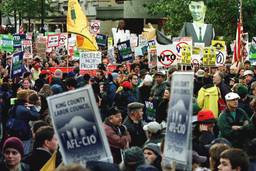
The majority of Americans want their elected leaders to know that globalization isn’t working for them. Democratic politicians have heard the message and are now taking a few first steps to better regulate America’s integration into the global economy.
The November elections – when 37 House and Senate seats changed from “free trade” to “fair trade” – created a Democratic majority that needed to stake out a new position on trade. Globalization and offshoring of jobs ranked among the electorate’s top issues, according to polls by Greenberg Quinlan Rosner Research and Public Agenda. Results in key races indicate that Democrats could have picked up even more seats with a stronger message on global economic issues, according to an analysis by Chris Slevin and Todd Tucker of Public Citizen’s Global Trade Watch, an organization critical of corporate-backed free trade.
Recent public opinion surveys reveal that Americans often support globalization in theory but criticize the reality. Steelworkers President Leo Gerard put it this way: “I don’t know any worker or trade unionist who is against trade, but we’re against exploitative trade that pits worker against worker, and country against country, and that’s what this current round of globalization has brought.”
In a March Wall Street Journal/NBC News poll, Americans agreed, by a margin of 46 percent to 28 percent, that trade deals have harmed the United States. And late last year, a Pew Research Center poll found that nearly 44 percent of the people surveyed thought free trade had lowered wages, compared to 11 percent who thought it had raised wages.
The majority of House Democrats have opposed most previous trade deals, even more so under Bush than Clinton. But key leaders – including Speaker Nancy Pelosi, House Majority Leader Steny Hoyer and Democratic Congressional Campaign Committee Chairman Rahm Emanuel – have often supported free trade deals in the past. And the party’s influential business-financial supporters have largely embraced the same free trade agenda as the Republicans.
However, in March, Rep. Charles Rangel (D-N.Y.), chairman of the House Ways and Means Committee, with a mixed voting record on trade issues, proposed a “New Trade Policy for America” that sets conditions for the administration to win Democratic support for recently negotiated trade agreements with Panama, Peru, Colombia and South Korea.
Rangel would make all trade agreements require enforcement of core International Labor Organization (ILO) rights – such as the right to organize and prohibitions on child labor, forced labor and discrimination in employment – through the same dispute settlement mechanisms used to enforce business interests, like intellectual property rights. His proposal, hastily endorsed by the House Democratic Caucus, also insisted on enforcing multilateral environmental agreements, establishing a fair balance between poor countries’ access to drugs and pharmaceutical company patents, ensuring that government procurement promotes worker rights and guaranteeing that foreign investors in the United States are not granted greater rights than American investors (reversing one of NAFTA’s most controversial provisions).
Rangel’s proposal also called for more strictly enforcing existing trade laws, pressuring China to revalue its currency, opening markets for U.S. exports, increasing assistance for retraining displaced workers and expanding help to the world’s poorest countries.
Bush administration officials did not dismiss the proposal out of hand, but they are unlikely to accept it without modifications, which would then lose crucial Democratic support. Fair trade advocates were cautiously optimistic. “It’s a good step trying to fix what’s awful,” says Slevin, deputy director of Global Trade Watch. The AFL-CIO did not immediately endorse the deal, but Policy Director Thea Lee says, “This is a good step forward, but if there’s any weakening, all bets are off.”
The administration doesn’t want to include ILO core rights, preferring to require only that countries enforce their own laws or the equivalent of American labor laws. Free trade ideologues argue that including ILO-defined rights in the agreement could lead to challenges under future trade agreements to American labor laws. “In a rare show of honesty by the administration, they acknowledge in their proposal that labor standards in the U.S. are so bad that they fear they no longer meet ILO standards,” AFL-CIO secretary-treasurer Rich Trumka says. In any case, neither Democrats nor unions would accept anything short of ILO core rights.
But the issue is not only standards but also writing tougher enforcement mechanisms into any agreement. Despite requirements under the Central American Free Trade agreements to strengthen worker rights, recent reports in the New York Times and Washington Post about Guatemala highlighted the use of child labor, an assassination of a labor leader and other labor rights violations. Serious labor rights violations also have occured in Jordan, even though the Clinton-negotiated labor rights provisions there were the strongest of any recent trade agreement.
Bush’s new trade agreements faced an uphill battle even before Rangel’s challenge. Unions and human rights advocates will oppose any agreement with Colombia, where 77 trade unionists were killed last year. And American auto, agricultural and other industrial interests, as well as unions, have spoken out against the Korean trade deal, which South Korea’s unions and farmers oppose. U.S. fair trade advocates also criticize the Peru and Panama agreements but more for the damage they’re likely to cause those countries than for harm to the United States.
Slowing down ‘fast track’
Beyond the negotiations over the new Democratic conditions for accepting the four signed trade agreements, a bigger battle looms this summer over renewal of “fast track” authority that gives the executive branch the power to push for approval of trade agreements with little debate and no amendments. Fair trade advocates are determined to block its renewal. They also propose an alternative arrangement that would grant Congress a bigger role. Under the AFL-CIO’s proposal, similar to principles endorsed by the Change to Win labor federation, Congress would set “readiness criteria” to determine what countries qualify as potential negotiating partners and to mandate objectives on labor rights, the environment and investment. Then Congress would have to certify that the agreement meets those objectives before it would vote under rules of expedited debate and without amendment.
The battles over both the new trade agreements and fast track are likely to be more important politically than economically. If Democrats stick to their new principles and reject or replace fast track, they will signal a new direction for the party and raise the bar for global economic negotiations. That is likely to both help Democrats in the next election and to pressure presidential aspirants and free trade Democrats to adopt the new perspective.
“People aren’t idiots,” Lee says. “Everyone can read the results of the last election and look forward to the next election and see that trade and the middle-class squeeze will be central issues. I don’t think anyone on the Democratic side wants to see a messy split on trade.”
Easier said than done
But actually relieving the pressure squeezing American workers will take bolder action. With the world already wide open to trade and investment, new trade deals will have relatively little effect for good or ill until the new rules are applied globally. “If we had a law saying no more trade agreements, it wouldn’t make that big a difference,” says Dean Baker, an In These Times contributing editor and co-director of the Center for Economic and Policy Research (CEPR), a Washington think tank.
Global currency exchange rates, especially the undervalued Chinese currency, also make a big difference, according to Baker and trade economist Robert Scott of the Economic Policy Institute (EPI). “We cut deals,” Scott says, “then countries devalue, and that wipes out everything.” For example, with the Chinese rembini undervalued, Chinese goods are artificially cheap, contributing to China’s huge trade surplus and the record $764 billion United States trade deficit last year.
At the same time, the overvalued dollar makes American products more expensive on the world market. If the dollar declines in value, U.S. exports should be more competitive. But because U.S. multinational corporations have moved so much of their production overseas, the United States has lost some of its ability to take advantage of a weaker dollar. Simply lowering the value of the dollar will not quickly restore America’s exports. Indeed, the dollar’s value has declined sharply for three years, but the trade deficit has continued to soar. The trade deficit could be reduced by greatly constricting the American economy, but the payback for years of trade deficits will pinch hard.
A new political direction on trade would likely lead to a “strategic pause” in pursuit of free trade agreements, which has been advocated by Jeff Faux, distinguished fellow at the EPI. During that pause, the country could evaluate the successes and failures of the past decades, then decide how to move forward, possibly renegotiating past trade agreements according to a different model for the global economy.
False advertising
The momentum for new agreements is fed by relentless projections of the financial gains from trade liberalization. But the economic gains are much smaller for the world economy than free trade apologists have argued. Moreover, the distribution of those gains is skewed. Free traders argue that the vast majority of Americans gain from free trade through lower prices, even if a few people are hit hard by job losses. But the losers from free trade are numerous, and little is done in the United States to compensate or to help any of them.
For example, rather than NAFTA being a win-win-win for Mexico, Canada and the United States, wages of workers in all three countries have stagnated since it was implemented. A study from the New School for Social Research, harshly critical of the models used to estimate trade gains, concluded that full liberalization of world trade would add so little that it “is equivalent to a rounding error in a $44 trillion world economy.” Faux argues that even these studies, by focusing on trade alone, fail to account for both the damage caused by U.S. investment and technology flowing overseas, and the erosion of workers’ bargaining power at home.
The rich, in any case, capture most of the gains from globalization. Academic studies typically conclude that trade accounts for 20 to 40 percent of the recent increase in inequality in the United States. Even the International Monetary Fund found that “labor globalization has negatively affected the share of income going to labor in the advanced economies.” EPI economist Josh Bivens calculates that the median household in the United States was $1,500 poorer in 2005 than it would have been if trade had remained at the 1979 level, even taking into account cheaper prices. Most people, not just the displaced textile or auto workers, are poorer as a result of globalization.
Broadly based and progressively financed policies like national health insurance and better public pensions would help all families hurt by globalization. But workers who lose their jobs permanently – whether from globalization or technology – deserve additional targeted help. Existing programs are narrowly conceived – excluding workers who produce services or most parts suppliers indirectly hit by plant closings. And they are even more narrowly administered: The Bush administration’s Labor Department denies trade adjustment aid to three-fourths of those workers lucky enough to be certified as eligible. What’s more, the programs are stingy and force people quickly into poorly paid jobs.
The United States needs more generous income support and extended training programs, as well as strengthened unemployment insurance, which now covers less than 40 percent of the unemployed and offers pay replacement rates among the lowest in the industrial world.
But current proposals for wage insurance, which would typically pay half the difference between a displaced worker’s old and new jobs, would push workers quickly into inferior jobs with little prospect of creating new skills and better jobs that both workers and the national economy need.
In order to make globalization work for working Americans, Faux argues for policies that make the American economy more competitive (such as promoting manufacturing and investing in research and technology development), strengthen labor unions, expand social benefits, revise NAFTA and negotiate new rules for global trade. Harvard political economy professor Dani Rodrik argues that national governments need more power to craft their own responses to global markets, and that future WTO talks should focus not on further liberalization but on giving both rich and poor nations “policy space” to respond to their citizens’ needs.
It’s possible that the champions of globalization have no interest in serving the needs of citizens. “They never intended it to be good for American workers,” says the Steelworkers’ Gerard. “They intended it to be good for Wall Street and American financiers. The rich have gotten richer, and the rest of us have taken it on the chin.”

David Moberg, a former senior editor of In These Times, was on staff with the magazine from when it began publishing in 1976 until his passing in July 2022. Before joining In These Times, he completed his work for a Ph.D. in anthropology at the University of Chicago and worked for Newsweek. He received fellowships from the John D. and Catherine T. MacArthur Foundation and the Nation Institute for research on the new global economy.