Donate today and get a free, signed copy of Rick Perlstein's new book Nixonland: The Rise of a President and the Fracturing of America!
ZoomZoom InZoom OutPrintDiscuss
Features > June 18, 2007

What Vacation Days?

Despite being one of the richest nations, America denies its workers mandated paid vacations and sick days

By David Moberg

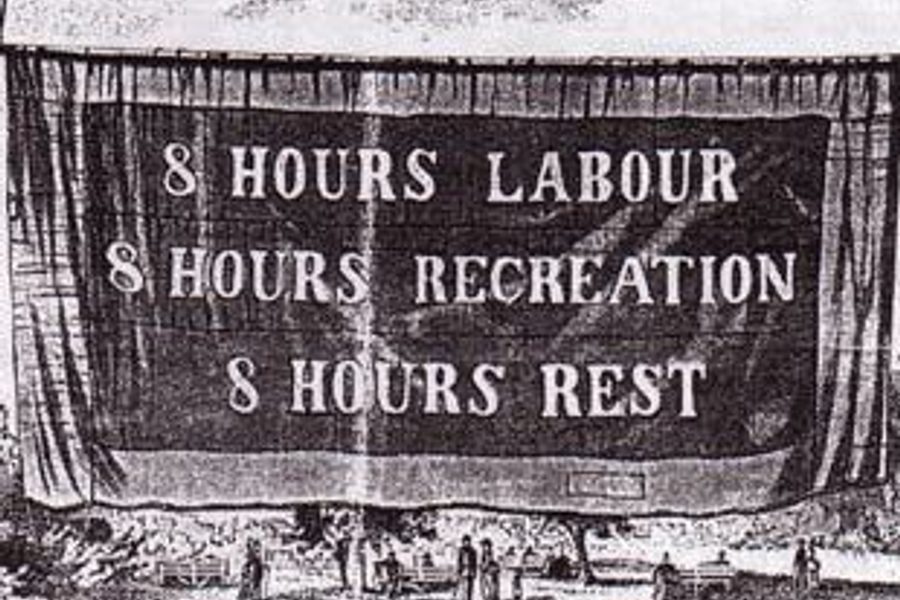
Eight-hour day banner, Melbourne, 1856

Last year Mary Lou Eckart took her first vacation in five years, a trip from her home in Decatur, Ill., to see her grandchildren in Florida. But the Illinois state government, which pays her to care for a severely disabled teenage girl, provides her no paid vacation time. So Eckart took the girl—and her work—with her.

She faces a similar bind if she gets sick. “I just had an incident two weeks ago,” she says. “I had an inner ear infection that I didn’t know about, and I passed out. My 17-year-old daughter covered for me while I recovered. I get no paid vacation, no time off, no sick leave. But if they put these clients in a nursing home, I know that is very expensive. I’d love to have a vacation. I’d love to be able to get away. I’d love to have someone fill in for me. I feel like we deserve more than what we’re getting.”

Eckart’s story is all too common: Nearly one-fourth of American workers have no paid vacation or holidays, according to a recent study from the D.C.-based Center for Economic and Policy Research (CEPR), and nearly half of all private sector workers have no paid sick days. But if Eckart were living in any other industrialized country, she would be legally guaranteed at least two weeks paid vacation and—in 136 countries—from seven to more than 30 paid sick days. The United States is the only rich country that does not mandate paid vacations and paid sick days, and Americans who are afforded such benefits enjoy far less time off than workers in other wealthy nations.

Americans now work more every year, on average, than workers in any other industrialized country (except for a virtual tie with New Zealand). With women working longer hours each year, the average annual work time for a married couple is growing steadily, and family time—including the crucial bonding experience of vacations—has suffered. Full-time workers in much of Europe typically take seven to eight weeks of vacation and holidays each year—that’s double the American average for full-time workers. Overall, the average private sector worker in the United States gets about nine paid vacation days and six paid holidays each year. Low-paid, part-time or small-business workers typically get far fewer, sometimes none. The same holds for paid sick leave: 72 percent of the highest-paid quarter of private sector workers get paid sick days compared to only 21 percent of workers in the lowest-paid quarter.

Intercontinental disparity

Why do workers in other rich countries have more paid time off? Mainly because laws demand employers provide it. The European Union requires its members to set a minimum standard of four weeks paid vacation (covering part-time workers as well). Finland and France require six weeks paid vacation, plus additional paid holidays. Most countries require workers to take the time off and employers to give them vacation at convenient times. Some governments even require employers to pay bonuses so workers can afford to do more than sit at home on vacation. On top of that, unions in Europe and other rich industrialized countries—whose contracts cover up to 90 percent of the workforce—typically negotiate additional time off. Meanwhile, the standard workweek is slightly shorter in many European countries, and workers retire earlier with better public pensions.

Until the early ’70s, European and American workers logged similar hours. But the pattern then drastically diverged, with Europeans getting more vacation time, around the same time that U.S. income inequality began growing. In the United States, corporations gained the upper hand against workers and their declining unions, and the Democratic Party started shifting away from working class concerns. In Europe, stronger unions and left political parties pushed for shorter work hours. In some cases, as jobs were lost when traditional industries restructured or work was outsourced, unions saw reduced work time as a way to share work. But more often, unions were continuing the battle to share wealth in the form of more leisure, which had started a century earlier with the movement for an eight-hour day—the goal of Chicago protestors in May, 1886, that ended in the Haymarket Massacre, repression of the labor movement, and creation of May 1 as the international workers’ holiday.

The difference in work hours between the United States and most industrial countries “is exactly a manifestation of the same forces driving broader inequality,” says CEPR economist John Schmitt, pointing to deterioration of the minimum wage, pensions, public services, health insurance and wages under pressure from globalization, deregulation, privatization and attacks on unions. “Workers haven’t been able to translate higher productivity gains into higher pay or benefits, and they’ve been unable to address the time crunch.”

“People in the United States don’t even understand what could be possible on this issue [of paid time off],” Schmitt says. “This is one of the most important ideological victories of the right in the last 30 years—to persuade us we aren’t rich enough to treat workers well. We’re incredibly rich, getting richer every year, and we have plenty of resources to pay adequate wages, pensions, health insurance and vacations, but we’ve chosen to give that money to the top five percent.”

European and other industrialized countries have divided their growing ability to produce differently. For example, Europe has nearly caught up with—and many countries have pulled ahead of—the United States in labor productivity (the output from each hour of work), the key measure of an economy’s potential.

In recent years, however, American workers have rapidly increased the amount of goods and services they produce each year, in comparison to Europe. These two measurements have largely diverged because Europeans have been enjoying more time away from the job, just as they’ve been enjoying a more egalitarian society.

According to Harvard economist Alberto Alesina, Europeans are happier, and have less stress and insecurity, which is good for health and longevity. Studies in the United States, for example, indicate that taking vacations cuts in half the risk of heart attacks for men. Longer, mandated vacations haven’t undercut the competitiveness of other rich countries, and there’s evidence that they increase labor productivity.

Plus, recent increases in the U.S. gross domestic product haven’t significantly helped most Americans: The super-rich have captured most of the income gains. An accurate calculation of the gross domestic product—subtracting such costs as crime, environmental depredations, militarism and declining social trust—would actually show that growth in economic output has brought few, if any, real gains in welfare for American society. Indeed, CEPR economists David Rosnick and Mark Weisbrot argue that Europe’s shorter work hours help the environment by reducing energy consumption and carbon emissions.

Taking back time

Most Americans would be better off with more paid vacation and leave, but inequality, insecurity and the competitive rat race drives people to work even harder, often just to keep their heads above water. It’s very difficult for individuals to demand more time, even if the limited polling available suggests it would be popular. Major gains will only come from an organized movement and changed laws. One organization, Take Back Your Time, founded by writer and documentary filmmaker John de Graaf, is trying to persuade presidential candidates to support its proposal for mandating three weeks of paid vacation for all workers. “I think the political figure who would pick up on this issue would find great resonance,” De Graaf says, but so far nobody has.

At this point, more modest proposals have a better chance to succeed. Sen. Ted Kennedy (D-Mass.) and Rep. Rosa DeLauro (D-Conn.) have introduced the Healthy Families Act, which would guarantee seven days of paid leave for all workers to deal with their own or a family member’s illness. Beyond the obvious help to the individuals who need care, such legislation would help businesses economically. Rather than putting in an unproductive day at work spreading communicable diseases (or sending their sick child to spread illness at a child care center), workers could just stay at home, and it would reduce the employee turnover that results from workers taking off unauthorized, unpaid sick days. Five states have mandatory temporary disability insurance programs to cover income losses from short illnesses, and last November, San Francisco voters approved the first mandated paid sick days in the United States. The Working Families Party in New York is now campaigning for paid leave for new parents and adults caring for ailing relatives, a protection California passed in 2004 (thus strengthening the unpaid family and medical leave federal law provides).

Mandated paid sick days would help workers like Elnora Collins, a home care worker in Chicago. “If you get sick, you go to work sick. If you show up for work, you endanger your patients. If you don’t show up for work, you get no pay. I recently lost a whole day’s pay, because I ended up in a hospital for an overnight stay. It was an anxiety attack, like a heart attack. It’s very frightening. And then, when you look at that paycheck, you really cry.”

Compare the work time and leisure in the United States to that in other rich countries, and we all have good reason to share in her tears.

David Moberg, a senior editor of In These Times, has been on the staff of the magazine since it began publishing. Before joining In These Times, he completed his work for a Ph.D. in anthropology at the University of Chicago and worked for Newsweek. Recently he has received fellowships from the John D. and Catherine T. MacArthur Foundation and the Nation Institute for research on the new global economy.

More information about David Moberg
  • subscribe to print magazine

  • Reader Comments

    Here is an “advertising approach” that could quickly get the ideas in this article across to the American public:

    25% of the American workforce earns less than the MONETARY minimum wage of modern European countries (not counting Portugal, Malta, etc.).  That doesn’t count the benefits a European minimum wager gets: 4 weeks PAID vacation, 10-12 PAID holidays, 3 months of PAID maternity leave, a year of PAID sick leave, severance pay (from McDonalds!)—oh, and don’t forget PAID health care.

    The total must add up to more like 35% or even 40% of American workers earning less than minimum wage earners in Europe!!!  That sounds like an all-in-one country waker-upper to me—what I would run on if I were running.
    ***********
    A similar economic alarm clock might be explaining to one and all that the federal poverty line is based on completely arbitrary—and ridiculously understating— formula of three times an emergency food budget (emergency meaning you cannot even buy canned beans, only dry beans and soak them) which accidentally happened to coincide with a realistic poverty estimate in 1955 when it was developed—which was already understating real poverty because of the divergence of food prices with the cost of overall needs by 1965 when it was adopted—which is off by double at this point in the twenty-first century.

    Meaning that real poverty in America is now 25%—not 12.5% as measured by the food-only formula; up from 14.5% at the time LBJs war on poverty began—in spite of doubling (!) of average income since the war began.

    Some want to quibble that the official poverty line does not count income like food stamps, etc.  Fine; I’ll take 25% American poverty without food stamps, etc—40 years into the war on poverty and double the per capita output since.  Good enough shock all of America awake at once.

    Posted by ddrew2u on Jun 18, 2007 at 10:41 AM

    Hi, y’all!

    Workers are a commodity to management, plain and simple, as are livestock to a rancher. They are treated as an expense to be weighed against profit. This has been the way business has operated for the past twenty-five years, and allowed to do so by our wonderful ersatz populism-spewing GOP who throw bones to the workers while giving the filet to their rich, and campaign contributing, friends. 

    Really should we be surprised that we are worked more in a society which allows business to dictate government policy?

    Ta- ta!

    Posted by Aunty Rightwing on Jun 19, 2007 at 12:51 AM

    Moberg’s bio says…

    “Recently he has received fellowships from the John D. and Catherine T. MacArthur Foundation and the Nation Institute for research on the new global economy.”

    He cites many benefits of European workers which have long been true. We probably could have had “mandated” vacations, early retirement, etc. also if willing to pay the price. Frankly, when we were in London for our first time (1991) and I saw the price of gasoline ($5 US gallon equivalent) a pair of Levis ($50) which included the the VAT on all items, I was just as happy to have lower taxes and be able to choose to pay for my own perks.

    The extreme example of personal benefits at government mandate/taxpayer expense is, of course, Sweden. When my relatives left there a century ago there were two classes — those who had it all and those who had nearly nothing. (The “Hads” stayed there.)

    Recently the Europeans have been leaning toward cutting some of these expensive mandates. they’ve been talking of a longer work week, later retirement, but I have heard of no tax cut plans. The balance of benefits versus taxpayers has created serious tax dodging which makes Al Capone look like a piker. As globalization squeezes their businesses the move is on to return to a practical level of working time, and benefits.

    As word of Sweden’s land-of-the-free-everything got around there was no fence (and no defense) or attempt to stop the inflow of immigrants. they are currently in a real battle (quite literally) against Muslim dominated enclaves. (Look up Malmö, Sweden for an example.)

    Although my first thought is, “Mary Lou should refuse to work for the state under those conditions,”

    I must think again. I was self employed nearly all my life and had no benefits, not even eligibility for workman’s comp or unemployment. If I had an unreasonable client, I finished the job and never worked for them again. I was fortunate to be in a boom time for advertising in the US and arrogantly thought others had it as easy as I.

    That gradually changed as the Cold War ended, computers and robotization changed the entire manufacturing scene and the locally owned companies who were my clients became a small part of huge, impersonal corporations.
    In a very short time span I began to learn a little of what it was like for my paternal grandfather, Swedish immigrant and coal miner, before the union existed.

    There should be a middle ground somewhere for people like Mary Lou Eckert. The family owned companies I began working with in the late 1950s genuinely cared about the individuals who were like an extended family. A few still operate like that here — but they are losing out to the offshoring, out sourcing and bipartisan sale of our heritage.

    I have a list of people I know by name who have lost out to globalization. Yesterday a visit with relatives added names 55 and 56. The sons of two of my cousins have begun the downward spiral at ages 44 and 46. One is a lawyer in California, the other a computer programmer in Atlanta — their jobs went to India just last month.

    There is no color color of educational level which is secure. Our representatives are even less interested in our job security than our homeland security.  Their jobs, their perks, their benfits are secure even when caught goofing off on company time.

    Clinton? — “It was only sex.”

    DeLay? — Do you think even if convicted he would lose his pension?

    Governor What’s-his-name out east — 90 miles an hour, no seatbelt, appology — same driving on the way home!

    What do horsemen know of tired feet?

    Posted by whattheheck on Jun 19, 2007 at 6:53 AM

    Whattheheck,
    Taking Europe’s $9.50/hr minimum wage as an example—the American version of that could be a $12.50/hr minimum wage, w/o the 4 weeks vacation, paid holidays, etc.; but with health care.  Americans would probably rather have the money; Americans would probably work on their vacation anyway.

    Point is, total comp here stinks because we don’t know enough (culturally, common knowledgewise) to protect labor in the free market—we lack an inbuilt understanding of the need for checks and balances (read unions)—what amounts to super complacent labor.

    A $12.50/hr minimum wage would add all of 4%, one time, to direct costs of GDP output—about how much we grow per capita every two or three years.

    A $12.50/minimum wage would probably put an end to street gangs.  No relatively spoiled, native born American is going to work for a 1939 minimum wage ($4.50 w/o tax).  Combine a 1939 minimum wage with today’s prohibition (drugs) and you get East L.A.’s version of Al Capone.

    A $12.50/hr minimum wage would give 40% of Americans a raise.  If any two people could earn $1000/wk doing anything there wouldn’t be much poverty.  All the years I read all the magazines and books and watched all the talking heads I never realized we could end poverty in America just by paying people enough to work.  It’s all in the eighth-grade math.

    Posted by ddrew2u on Jun 19, 2007 at 7:31 AM

    ddrew,

    While I personally have no problem with a minimum wage, (it should be COL adjusted) I’m afraid the $12.50 would be no panacea. Not long ago I saw what was referred to as a”Living Wage” scaled to the cost of living inn various states. Hawaii was the highest with over $22/hr and Alaska was near that.

    We will never settle on an overall satisfying minimum wage or benefits package things have obviously been sliding the opposite direction.
    Personal and corporate greed seems to be increasing. Whether it is the CEO, sports star, movie actor or some other overpaid premadonna — there is no apparent limit to some people’s desire for more.

    As for wiping out street gangs — I doubt it would have any effect. The money from drug dealing has the easy money appeal of the lottery and the expectations are higher than any dollar per hour figure could beat.

    “If any two people could earn $1000/wk doing anything there wouldn’t be much poverty.  All the years I read all the magazines and books and watched all the talking heads I never realized we could end poverty in America just by paying people enough to work.  It’s all in the eighth-grade math.” — You’ve lost me on this part.

    As for your 1939 figure — it’s is way too high. My father-in-law was working a factory job then at $0.40/hr. I have a copy of my dad’s Federal Tax return while working full time (also in a factory job) his total income was less than $2,000 and his tax = $43 — his Social Security = $7.

    There is usually a general tug of war between labor and management. I have seen some really good cooperation within select companies which worked very well, but that is nearly all gone. As we have more transnational corporations it will likely be less advantageous for the worker.

    When auto unions were too strong here the quality dropped, cost jumped and the foreign competition began to take over. I sold my 1973 Pontiac LeMans, bought a VW and have had at least one ever since. (My 1991 Jetta GLI is still great and fun to drive.)

    We are now at a point where management has gained too much leverage through use of cheap foreign labor and lax foreign (Asian) working restrictions and regulations.

    Aunty Rightwing hit it on the nose, “Workers are a commodity to management, plain and simple, as are livestock to a rancher.”

    I’ve read several books on the globalization process and remember one CEO quoted as saying, “We see employees as appliances — when we need them we plug them in and when we don’t, we just pull the plug.”

    What we need is to all treat people like they are worth what we each think we are worth.

    Posted by whattheheck on Jun 19, 2007 at 1:14 PM
  • extended discussion >>>Continued...

    Discussions with more than 5 comments are continued on our special discussion page to encourage continuity and ease of use. There are currently 12 posts.

Join Here
Member Login

Forgot password?

Article Appeared in this Issue

Full contents
Past issues

Also by David Moberg

Donate now
and get a
free, signed copy
of David Sirota's New York Times bestseller The Uprising: An Unauthorized Tour of the Populist Revolt Scaring Wall Street and Washington

Popular Discussions