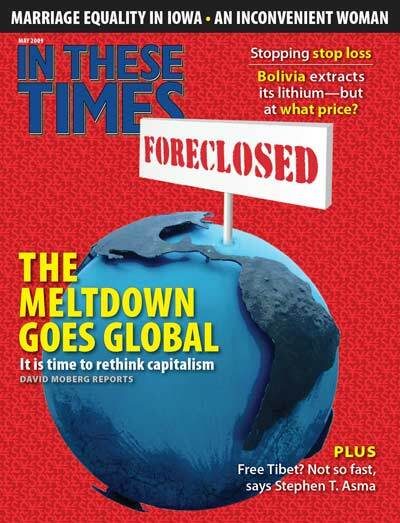
Only a year ago, the United States seemed likely to be the main victim of its own bursting housing bubble and financial crisis. Now the American collapse has deepened – and spread worldwide.
Economic activity is shrinking in nearly every country, with Japan facing the steepest drop among the Group of Seven rich countries. Even in red-hot China, unemployment has become a major problem. This year, for the first time in 60 years, the world economy will contract.
It’s a global crisis – and a crisis of globalization. But is there a global cure?
In the ominous shadow of the failed 1933 economic summit in London, Group of 20 (G20), made up of the richest countries and big emerging economies, like China and India, met in London on April 2, as In These Times went to press. With many details still missing, G20 members pledged $1.1 trillion in new resources for the International Monetary Fund (IMF) and other international financial institutions. They also agreed to new coordinated and global financial regulation, including action on hedge funds, tax havens, credit rating agencies and executive compensation. And they committed themselves to free trade and sustainable development.
The problems were never going to be resolved in one meeting. Two major, intertwined crises exist. First, jobs, income, credit and economic activity are spiraling into a self-reinforcing, deepening collapse. Second, the model of capitalism that dominates the global economy is failing and must be radically reformed.
The initial challenge for world leaders is to stop the downward spiral and re-start the world economy. During recent financial crises – such as the bursting of Japan’s real estate bubble in the ’90s, or the 1997 Asian currency crisis – growth was strong enough throughout the rest of the world to help the stricken countries eventually recover.
But the spread of financial derivatives from U.S. institutions – combined with similar financial deregulation elsewhere (particularly Iceland, Ireland and much of Eastern Europe) – exposed banks and investors to risks from their collapse.
Worldwide, according to the Asian Development Bank, the value of financial assets fell by roughly $50 trillion in 2008, equal to world output (GDP) for a year. With less wealth and a frozen credit market, business and consumer spending contracted. People lost jobs and income. Governments lost tax revenues.
With each new contraction, the vise tightens. Although Asian banks had largely avoided America’s inscrutable new financial devices – such as credit default swaps – their countries’ economies relied heavily on exports to the United States. Central banks in China, Japan and elsewhere financed the debt-driven consumption by buying and holding huge dollar-denominated reserves, partly as protection against a recurrence of the ’90s currency crisis, partly to support their export-oriented development strategy. But with their American market shrinking, industrial output dropped precipitously, down in Japan by half in February from a year earlier.
Workers around the world are encountering wage cuts and rising unemployment, with the International Labor Organization (ILO) estimating that 50 million jobs may be lost in 2009. Beyond the personal hardship, this also depresses demand. And the poorest countries are the most vulnerable. Hard-hit in recent years by spiking oil and food prices (driven largely by speculation, according to a new study by the U.N. Conference on Trade and Development), the world’s poor countries face declining exports, shrinking remittances from migrant workers, growing extreme poverty and declining aid from abroad.
A stimulus too small
With U.S. interest rates near zero; with American consumers too poor and indebted to continue spending wildly; and with demand plummeting around the world, governments have to step in and run up deficits as they spend on projects that create jobs, generate income and permit workers to buy products.
The United States – with the backing of the global labor movement and many business leaders – urged other G20 countries to increase spending and deficits. The more coordinated the response, the stronger the stimulus will be and, equally important, the less likely governments will be to turn to nationalist strategies to avoid giving other non-participating countries a free ride.
The IMF proposed that governments spend 2 percent of their GDP on stimulus plans. But thus far, advanced economies had allocated only 1.3 percent – less than in emerging economies, according to an ILO study.
The Economic Policy Institute (EPI), a U.S. think tank, calculates that while China is committing 3.6 percent of GDP, the United States 2.7 percent, and Japan 2.0 percent to stimulus packages, the European Union’s 13 largest economies averaged only 0.78 percent of GDP – far too little, even when taking into account Europe’s generous policies that pay unemployed workers and keep incomes stable in hard times.
Many countries need outside help to respond to the crisis, and President Obama called for tripling funds for the IMF. But the IMF has continued to impose conditions on loans that will only dampen demand and worsen the lot of workers and chances for economic recovery. Those conditions include cuts in public budgets, wages and social safety nets, as well as hikes in interest rates, according to a survey by the Third World Network, a Malaysian-based nongovernmental organization. Besides changing its lending policies, the IMF needs to reform its governance to give developing economies more control.
The global stimulus must be bigger and more coordinated, but it will not function well if American financial institutions remain in disarray. Treasury Secretary Timothy Geithner’s plan for public subsidy to private investors in bad bank assets is a big disappointment on this front. If it works at all, it is likely to be much slower, confusing, open to abuse, and costly to taxpayers than straightforward nationalization of insolvent banks.
But even if a stronger stimulus and bank clean-up pull the world out of a looming depression, this crisis has demonstrated the failure of the “Anglo-American” model of capitalism, as even many staunch defenders of capitalism acknowledge.
“Another ideological god has failed,” Financial Times columnist Martin Wolf wrote on March 9, referring to the neoliberalism – deregulation of markets, combined with state support for corporations – that President Ronald Reagan and British Prime Minister Margaret Thatcher first promoted aggressively in the ’80s. “The era of liberalisation contained seeds of its own downfall.”
Former Federal Reserve Chairman Alan Greenspan admitted his fundamental operating assumptions that banks would wisely judge how much risk they could assume had been wrong. Former General Electric Chairman Jack Welch now says that the notion he promoted – that corporations should just focus on shareholder value – is “the dumbest idea in the world.”
The entire contemporary financial system was based on the assumption that financial markets were always efficient and rational. That idea fell off the cliff along with the world economy that it helped to wreck.
Green Keynesianism
Beyond preventing a greater global meltdown, the world – and not just the leaders at G20 meetings – must rethink capitalism. Unlike the ’30s, when socialists, communists and others proffered alternatives, a similarly strong ideological challenge does not exist today.
On the left, what one might term green global Keynesianism does challenge the dominant economic order. Like the proposals of British economist John Maynard Keynes (1883−1946), this broad initiative calls for tighter global regulation of financial markets, stronger controls on multinational corporations, encouragement of balanced development and environmentally sustainable growth, and promotion of workers’ rights and security. And it combines such global coordination with the option of distinct national strategies.
The post-World War II Bretton Woods agreements that Keynes influenced provided a global framework for decades of solid growth. But that growth unraveled under the pressures of unregulated global finance. In 1971, when President Nixon ended the U.S. commitment to exchange dollars for gold, the new era of globalization began.
Not so coincidentally, that was also the occasion for launching the first financial derivatives: currency futures. In the subsequent decades, growing financial sector and capital mobility shaped the new global economy as much as free trade did. And corporations, international financial institutions, and leaders of governments like the United States used globalization as a bludgeon to force countries into believing there is no alternative to neoliberalism.
Possible solutions
Three broad steps must be taken to remake this failed, unstable model: one, regulating global finance; two, correcting global economic, social and environmental imbalances; and three, devising ways to make sure economic progress is aligned with social needs.
Leading up to the G20 summit, many Europeans, like German Prime Minister Angela Merkel, emphasized the need for new regulation. But the agenda, partly motivated by European anger at the failure of regulation in the United States, was relatively narrow and focused on longstanding bêtes noires that are legitimate, but not the most immediate, issues. Proposals included reining in tax havens, as well as hedge and private equity funds.
Geithner outlined part of a plan to reduce risk to the financial system that would increase regulations (such as raising capital requirements) and expand regulations (for example, to hedge funds, many derivatives and to financial institutions like AIG, the bailed-out insurance company).
But Geithner’s rules seem designed more to preserve and protect the present system than to transform it – for example, by breaking up institutions that are now “too big to fail,” banning many derivatives and treating financial institutions as tightly regulated public utilities.
Nobel economist Joseph Stiglitz, chair of a U.N. Commission of Experts on financial system reform, has laid out some basic principles for much more ambitious financial regulation and enforcement. He proposes making polluters of the financial system pay for the clean-up; greater competition to prevent any institution from being too big to fail; greater transparency, simplicity and democratic accountability for the financial system; and making sure regulators are not captives of either the institutions or the ideas of those they are regulating.
But Stiglitz’s ideas would be hard to implement globally. No institution, even with new powers, could easily enforce these rules.
Harvard economist Dani Rodrik says that a modest global regulation combined with strengthened national laws and enforcement would work best. Big countries, like the United States, will not yield sovereignty, he argues, and there’s a bigger risk if a global regulator gets policies wrong (as the IMF systematically has, according to Stiglitz).
Rodrik also argues that nations should have the right to make choices about how much financial stability or equality of income distribution they want and pick regulatory regimes that reflect those social values. But Rodrik’s formula also has a problem. Businesses could play one country off against another, so some degree of global coordination will be essential.
In addition to flexible but coordinated regulation, governments should also impose a small tax on financial transactions, such as buying and selling stocks, bonds and currencies. Such a tax would accomplish two objectives: It would discourage speculation by increasing the trading costs, and, in the near term, the tax would raise funds to pay for the costs of the meltdown. Over the long term, it could generate revenues to aid both development in poor countries and adjustment of all economies to a more socially and environmentally sustainable path.
One root cause of the collapse is the destructive imbalance between the financial and real economies. The real economy suffers as the inflated financial sector competes for capital, demands that managers take a short-term perspective, finances disruptive leveraged buy-outs, and drives up the value of the dollar (hurting the export of U.S. goods).
The casino economy encouraged Asian accumulation of dollar reserves, fueling debt-driven consumption to prop up the global economy, as the gap grew between countries with growing trade surpluses and growing deficits (most notably, between China and the United States).
The Financial Times’ Krishna Guha put it this way: “There is a strong case to be made that the current crisis is in the strictest sense a crisis of globalisation, fostered and transmitted by the rapid and deep integration of very different economies.”
For balance to be restored, two things must happen.
First, the United States – which has disproportionately served as the market for global exporters – must increase its exports, either through devaluation of the dollar (something dollar holders fear) or industrial policies that encourage exports (not of financial services, but of manufacturing), or both.
And second, export surplus countries, particularly China, must raise wages, expand social safety nets and increase domestic demand. China’s stimulus program includes first steps in this direction, and its proposal for a global currency would also help redress financial and trade imbalances.
World leaders must address other, related global imbalances with a combination of global and coordinated national policies, not leave solutions just to markets. In addition to being unfair and politically destabilizing, wildly uneven patterns of development, including rising inequality among nations and within most nations, threaten the global economy. The imbalance between growth and the environment, most critically manifested in global warming, threatens the planet. And the growing imbalance between the power of multinational corporations and workers endangers both popular democracy and wise regulation of the economy.
Resolving such imbalances and developing new mechanisms for control of finance ultimately requires finding new ways of making economic activity serve social needs, thus expanding democratic control of the economy. That means using markets, not being used by them. That means recognizing that markets are not the only mechanisms for delivering the goods and services people need.
Ultimately, trade is not an end in itself, but one means to the end – creating a better, more meaningful and stable life for all on a planet that is not endangered by the process.

Get 10 print issues of our award-winning, worker-first journalism here!

David Moberg, a former senior editor of In These Times, was on staff with the magazine from when it began publishing in 1976 until his passing in July 2022. Before joining In These Times, he completed his work for a Ph.D. in anthropology at the University of Chicago and worked for Newsweek. He received fellowships from the John D. and Catherine T. MacArthur Foundation and the Nation Institute for research on the new global economy.