Help In These Times raise $10,000 in three weeks! Donate now!
Help this website survive! Donate to In These Times now!
PrintDiscuss
Features » May 15, 2009

The Only Road Out of Crisis

Yes, it is socialism, but nationalize the banks already.

By Joseph M. Schwartz

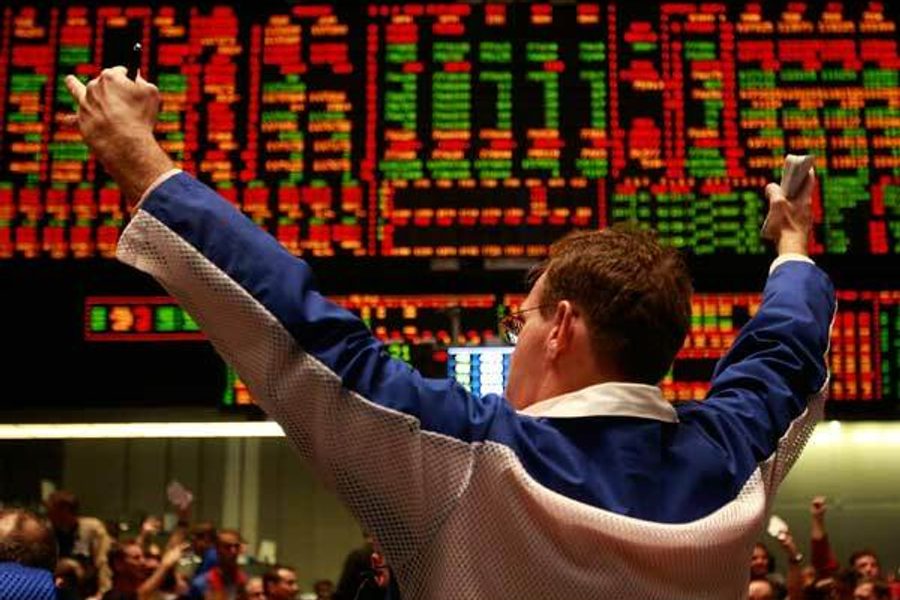
On Feb. 20, a trader signals an offer in the Standard & Poors 500 stock index futures pit at the Chicago Mercantile Exchange, after the White House calmed worries that the government would nationalize insolvent banks.

The federal government should maintain ownership of one major bank—a benchmark institution that would set standards that other banks would have to match.
Share   Facebook Digg del.icio.us Newsvine   StumbleUpon Reddit Furl Propeller

Since taking office, President Barack Obama and his economic team have confronted a daunting financial crisis with a string of solutions that have been hard to sell to a wary public.

Obama’s first problem is that his administration’s bank rescue has failed to break with the discredited Bush administration plan—throwing taxpayer funds at insolvent banks to put off their inevitable nationalization by the Federal Deposit Insurance Company (FDIC).

On March 23, Treasury Secretary Timothy Geithner proposed the latest rescue for big banks, whose “legacy assets” of housing-based financial derivatives have tanked in value. Geithner’s Public-Private Investment Program (PPIP) tries to revive the market for these toxic assets by having the government insure their value.

Some major financial institutions, such as Bank of America and Citigroup, are what Princeton economist and New York Times columnist Paul Krugman calls “zombie banks.” They live as private entities only because of the endless infusion of government funds that swamp their private stock market equity value.

Despite this quasi-nationalization, the Obama administration did not initially demand equity shares and, thus, majority management control in these banks. And after the stock market reacted negatively to an April 19 New York Times report that the administration was considering coverting government-owned bank warrants (essentially loans) to common stock, the proposal has gone unmentioned. But even going through with this measure (which would shore up the banks’ balance sheets) doesn’t mean the government will demand control of the banks’ management.

Federal regulators are doing their best to hide the dire situation of our megabanks, thus delaying official acknowledgment of their insolvency. The regulators have let banks off the hook, sparing them from having to “mark to market” declining assets while allowing them to use the declining prices of their bonds (which will have to be paid off in full if held to maturity) to lower their total liabilities. Thus, the recent quarterly reports of bank profits are largely accounting fictions.

Investors fail to renew lending

So far, the banks have gladly taken government funds, using them to shore-up their deteriorating balance sheets rather than to engage in renewed lending. A Wall Street Journal analysis published on April 20 shows the biggest recipients of taxpayer aid made or refinanced 23 percent fewer loans in February than in October—the month Treasury launched the Troubled Asset Relief Program (TARP). Although massive federal aid to financial institutions has failed to unlock the frozen credit markets, under PPIP, Geithner proposes to spend up to $1 trillion more in federal funds and insurance guarantees to create a “private market” for legacy assets.

“We cannot solve this crisis without making it possible for investors to take risks,” Geithner wrote in a Wall Street Journal op-ed.

Yet under PPIP, the federal government asks private investors (mostly the very hedge funds and private equity funds that speculated in these troubled assets in the first place) to risk just 7 percent of the purchase price of these assets. The federal government (that is, the taxpayers) will not only risk its own 7 percent but will also loan the banks the other 86 percent of the auction purchase price through the FDIC or Federal Reserve.

If the price of the asset has fallen more than 7 percent below the original auction purchase when the loan comes due in a few years, taxpayers will assume the loss on the value of the loan. That is, the public treasury will assume the risk on 93 percent of the private market purchase price, with the private sector risking only its original 7 percent investment.

Geithner knows that now there is no private market for these worthless assets—hence his plan to bribe private investors to get into the toxic-asset market. So much for a capitalist market that rewards successful risk and penalizes failure.

Here’s a better plan: Rather than continuing to pay inflated prices for toxic assets that cannot be sold on a truly private market, the government should simply take those assets off the books of distressed financial institutions, so that their balance sheets can be restored to health.

Just as in the Savings and Loan crisis of the early 1980s, the FDIC should take over insolvent banks and other financial institutions, place their presently valueless assets into a Resolution Trust Company and restructure the banks so that healthier balance sheets would support renewed lending.

Once the financial firms have regained their health, the FDIC could either resell them to private investors or the government could choose to run the banks. When, and if, the housing market recovers, so will the value of the toxic assets. The Resolution Trust Company could sell the toxic assets to private investors without expensive guarantees, and use the proceeds to repay the Treasury a portion of the funds the government infused into the banking system.

Critics—including conservative pundits and some moderate Democrats—claim the federal government does not have the capacity to run megabanks. But in practice, little would change in terms of the bureaucratic structure of the institutions. Nationalization only involves firing the top layer of management; mid-level managerial personnel would stay on, under the supervision of skilled FDIC administrators (recently unemployed bank managers would be glad to work for the FDIC).

Finally, rather than reselling all the restructured, nationalized banks to private investors, the federal government should maintain full ownership of at least one major bank. This bank could serve as a benchmark institution, setting standards for investment in community housing, alternative energy development and infrastructure that other private banks would have to match.

The disaster of deregulation

It’s one thing to fix the current crisis, but preventing a repeat will require reflection on how this happened in the first place. The disastrous experience of financial deregulation demonstrates that without public regulatory restraint, finance capital will engage in irresponsible acts of speculative swindling during financial booms and resort to excessively conservative lending during financial busts.

The deregulation of the financial industry has been a 30-year joint project of Republican monetarists and Democratic neo-liberals. This “free market” project began with the Carter administration’s deregulation of the Savings and Loans. It accelerated under Reagan’s gutting of the entire government regulatory apparatus, and culminated with the Clinton administration’s abolition of the Glass-Steagall Act, which had separated commercial banks from investment firms. Now, the very banks that create risky financial instruments also market these instruments to their own clients.

To restore a sane credit system, the federal government must first take the fiscally prudent step of nationalizing and restructuring insolvent financial institutions. Then the Obama administration must recreate an effective regulatory system for domestic financial institutions and cooperate with governments of other advanced and developing economies to build a global financial regulatory system that favors productive investment over speculation.

The other story behind our current economic crisis is global, neo-liberal capitalism’s race-to-the-bottom. Transnational corporations that scour the globe for the lowest labor costs fail to pay workers enough to purchase the goods and services they produce. Only if Chinese and Southeast Asian workers can form independent trade unions will they be able to force employers to pay them wages sufficient to consume the goods they produce.

In developed nations, with wages failing to keep up with productivity increases, workers went into debt to forestall declining living standards, which temporarily put off the impending global crisis of overproduction and underconsumption.

In the end, restoring a stable global economic system will require raising the floor under global living standards and working conditions and creating global regulatory institutions that insure that investment and trade benefit all working people.

The era of deregulatory free-market mania is crashing down upon us. We must revive the capacity of democratic governments to regulate the economy to serve people’s needs rather than the speculative desires of corporate elites to recover from the current global economic nightmare.

  • Help In These Times publish more articles like this. Donate today!
  • Subscribe today and save 46% off the newsstand price!
Joseph M. Schwartz is a professor of political science at Temple University. He is a Vice-Chair of Democratic Socialists of American and the author, most recently, of The Future of Democratic Equality: Reconstructing Social Solidarity in a Fragmented U.S. (Routledge, 2009).

More information about Joseph M. Schwartz
Share   StumbleUpon Facebook Digg del.icio.us Reddit Newsvine Propeller Furl
  • subscribe to print magazine

  • Reader Comments

    Schwartz -

    “The disaster of deregulation”

    Ummm, would you care to expand on that a little?

    Now, I can see that if the Democrats pass laws that require banks to give mortgage loans to people who have no income or assets, this would be not only unproductive, but stupid. 

    I suppose one moderately priced home in bankruptcy might have $10,000 in costs, and the home owner and/or lender (and/or the taxpayer now) will have to absorb that cost.  If that home is now underwater by $20,000, $30,000, or more, that amount will be absorbed by someone, probably the taxpayer.  So if you have several million homes in trouble, and each home has an associated cost of several tens of thousands dollars, soon you are talking real money. 

    But that does not explain any “disaster of deregulation.” You cannot, in fact, come up with a coherent explanation, independent of the Democrats’ mortgage fiasco, of what you just called the “disaster of deregulation.”

    But to understand the problems we face, you have to go back a few years.  LBJ’s War on Poverty cost $6.6 trillion (WaPo), the amount went straight to the national debt, the money was totally wasted, the WoP ended in an orgy of Democratic fraud and corruption, and the taxpayers are still on the hook for that $6.6 trillion plus all the interest that has been paid for the intervening forty-four years. 

    So, the cost of the Democrat’s mortgage follies are now piled on top of the cost of the Democrats’ War on Poverty in the national debt..  All that wasted money, and the prospect of a Marxist president, convinced prudent investors to protect their assets by withdrawing from the markets; who would willingly leave their assets exposed to Marxist inefficiency and corruption?

    When LBJ started spending money foolishly on the Great Society and the War on Poverty, the markets reacted by going sideways for seventeen years, including three recessions culminating in the Carter Catastrophe.  President Reagan pulled us out of that one.

    When Clinton and Greenspan stupidly let the dot.com bubble get out of hand, the NASDAQ fell $2-1/2 trillion in the year (2000)before Clinton left office.  President Bush pulled us out of that one.

    Who is going to pull us out of the Democrats latest wasteful folly?  You can bet your assets it will not be a Democrat.

    Posted by scorp on May 15, 2009 at 8:16 PM

    Laws do not/did not *require* that loans be given to low income buyers, scorp.  The laws simply gave low income borrowers the chance to participate by addressing red-lining (or attempting to).  It was the loan originators that got pressure put on them by Wall Street to sell those loans; Wall Street wanted the loans made, knowing full well that they would default. The loan originators had to produce, or die. Their bosses demanded that these loans be made. Loan originators made promises they couldn’t keep, and obfuscated a lot of information anyone with common sense would have rejected if they knew the facts.

    Assuming that you’re right, and it’s all the Democrats’ fault, do you—-a seemingly very intelligent person—- REALLY believe either party was going to prevent any of this stuff? Both parties are corrupt to the core. Both parties are owned by Wall Streeters. Neither party makes policy that makes any real sense for the nation.

    Go ahead and blame it on Clinton all you want. It doesn’t make a bit of difference now. Business-first Democrats AND Republicans shoved this shit finance legislation through at the state and national levels.  You don’t seem realize that the US has been very Marxist since the early 1900s—-BEFORE the USSR—- even happened. Marxism is a whole lot more than what you think it is. I’m not defending Marxism; I could care less about Marxism. I’m just saying that beliefs like yours have their head up your a**.

    Posted by M_in_Baltimore on May 15, 2009 at 10:18 PM

    M -

    I am amused and bemused that you would make patently false and ridiculous arguments on well-documented recent historical events.

    Not only did the Democrats pass laws penalizing lending institutions that did not issue toxic mortgages, the government issued policies that described, in detail, how these lending institutions were to fake the data to make non-eligible borrowers appear to be eligible for mortgage loans.  The relevant document is “Closing the Gap: A Guide to Equal Opportunity Lending” issued by FRB Boston in April 1993 and subsequently adopted as policy by FDIC and the Clinton Administration. 

    The document is twenty-nine pages long, but the print is large and there are many blank pages and spaces.  Depending on your attention span, you would do well to read it in full, and dispell your prodigious ignorance.

    Posted by scorp on May 16, 2009 at 12:04 PM

    M -

    ” ... do you ... REALLY believe either party was going to prevent any of this stuff?”

    Well, yes, one party has a long history of cleaning up the other party’s social and financial disasters.

    In the 1960s, LBJ and the Democrats passed the Great Society legislaltion and the War on Poverty.  The WoP alone cost $6.6 trillion over the next thirty years, failed utterly in it’s stated goal of reducing poverty, and ended in a morass of Democratic Party waste, fraud, and corruption.  Two years ago, the federal debt passed the $9 trillion mark, and almost exactly three-quarters, 75%, of that was Democratic Party legacy from the War on Poverty.  When the Democrats started spending the peoples’ money foolishly in 1965, the markets went stagnant for seventeen years, including three recessions, before Reagan revived the economy and initiated a period of unparalleled growth. 

    From 1996 to 1999, Clinton and Greenspan stupidly allowed the dot.com bubble to develop.  Like all economic bubbles, there was no net gain from all that economic activity, and a lot of pain.  The NASDAQ fell $2-1/2 trillion, half it’s total value, during Clinton’s last year in office.  Fortunately, Bush took the proper corrective actions, the damage was minimized, and growth resumed until the Democrats’ toxic mortgages hit us.

    You really ought to be more attentive to history and facts before you say foolish things.

    Posted by scorp on May 16, 2009 at 1:06 PM

    History?  None of us seem to have learned from history, have we? Foolish? Fine.

    I’m not going to sit here and defend any policy anywhere down the road the last 50 years. Petty “facts” arguments go nowhere. Anybody can cherry-pick “facts.”

    All I said is that both parties are corrupt to the core; both parties made the necessary moves to assure that their own complicity in the raping of this economy wasn’t exposed. They do that together; hand in hand. They do that with a lot of help from overseas banking, too. They all do that with “facts.” Nowhere is there any integrity or *wisdom*—- those get thrown out without thinking.

    All I know is that the earning base in the US was systematically demolished; that is abundantly evident. No manufacturing. Jobs crushed to subsistence level while financializations relentlessly increased. Let’s not overlook that the Republicans had a concrete majority going in Congress since the 90s. The dot-com bubble couldn’t have been prevented; the dot-com bubble was pure speculation. Speculation has been allowed to run rampant for decades. It’s a wildfire. The Fed didn’t have any say in the matter. Crooked bookkeeping and tax evasion maneuvers are also a factor. Add to that a bone-crushing war chest for an adventure that is increasingly evident was cooked up and exceedingly dubious. In a war economy, jobs get generated in the war industry. Everything is top secret clearance now. The number of people who can be vetted top secret are a very, very small proportion of the population. The rest of the job infrastructure slid into “service” jobs that pay bottom-feeding wages. Just where is the money necessary to keep the society stable going to be coming from under these conditions?

    The War on Poverty? What part of the word co-optation do you not understand?

    Cite facts all you want. Talk is cheap. The overall picture is what has to be grasped. If YOU are oh, so wise, run for office!  See how far you get.

    Posted by M_in_Baltimore on May 16, 2009 at 3:32 PM
  • extended discussion >>>Continued...

    Discussions with more than 5 comments are continued on our special discussion page to encourage continuity and ease of use. There are currently 8 posts.

Help this website survive! Donate to In These Times now!