Girls Gone Anti-Feminist
Is ’70s feminism an impediment to female happiness and fulfillment?
Susan J. Douglas

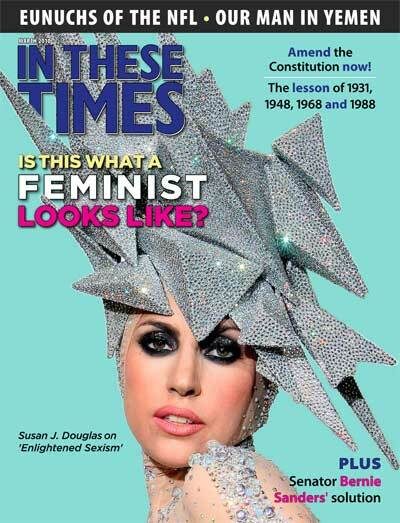
Spring 1997.
This was the Spice Girls moment, and debate: Were these frosted cupcakes really a vehicle for feminism? And how much reversion back to the glory days of prefeminism should girls and women accept – even celebrate – given that we now allegedly had it all? Despite their Wonderbras and bare thighs, the Spice Girls advocated “girl power.” They demanded, in their colossal, intercontinental hit “Wannabe,” that boys treat them with respect or take a hike. Their boldfaced liner notes claimed that “The Future Is Female” and suggested that they and their fans were “Freedom Fighters.” They made Margaret Thatcher an honorary Spice Girl. “We’re freshening up feminism for the nineties,” they told the Guardian. “Feminism has become a dirty word. Girl Power is just a ’90s way of saying it.”
Fast-forward to 2008. Talk about girl power! One woman ran for president and another for vice president. Millions of women and men voted for each of them. The one who ran for vice president had five children, one of them an infant, yet it was verboten to even ask whether she could handle the job while tending to a baby. At the same time we had a female secretary of state, and the woman who had run for president became her high-profile successor. And we have Lady Gaga, power girl of the new millennium. Feminism? Who needs feminism anymore? Aren’t we, like, so done here? Okay, so some women moaned about the sexist coverage of Hillary Clinton, but picky, picky, picky.
Indeed, eight years earlier, career antifeminist Christina Hoff Sommers huffed in her book, The War Against Boys: How Misguided Feminism Is Harming Our Young Men, that girls were getting way too much attention and, as a result, were going to college in greater numbers and much more likely to succeed while boys were getting sent to detention, dropping out of high school, destined for careers behind fast-food counters, and so beaten down they were about to become the nation’s new “second sex.” Other books like The Myth of Male Power and The Decline of Males followed suit, with annual panics about the new “crisis” for boys. Girl power? Gone way too far.
Fantasies of power
In 1999, one year before Sommers’ book came out, the top five jobs for women did not include attorney, surgeon or CEO. They were, in order, secretaries, retail and personal sales workers (including cashiers), managers and administrators, elementary school teachers and registered nurses. Farther down among the top 20 were bookkeepers, receptionists, cooks and waitresses. In 2007, when presumably some of the privileged, pampered girls whose advantages over boys Sommers had kvetched about had entered the workforce, the top five jobs for women were, still, secretaries in first place, followed by registered nurses, elementary and middle school teachers, cashiers and retail salespersons.
Farther down the line? Maids, child care workers, office clerks and hairdressers. Not a CEO or hedge fund manager in sight. And, in the end, no president or vice president in 2008. But what about all those career-driven girls going to college and leaving the guys in the dust? A year out of college, they earn 80 percent of what men make. And 10 years out? A staggering 69 percent.
Since the early 1990s, much of the media have come to overrepresent women as having made it– completely – in the professions, as having gained sexual equality with men, and having achieved a level of financial success and comfort enjoyed primarily by the Tiffany’s-encrusted doyennes of Laguna Beach. At the same time, there has been a resurgence of dreck clogging our cultural arteries–The Man Show, Maxim, Girls Gone Wild. But even this fare was presented as empowering, because while the scantily clad or bare-breasted women may have seemed to be objectified, they were really on top, because now they had chosen to be sex objects and men were supposedly nothing more than their helpless, ogling, crotch-driven slaves.
What the media have been giving us, then, are little more than fantasies of power. They assure girls and women, repeatedly, that women’s liberation is a fait accompli and that we are stronger, more successful, more sexually in control, more fearless and more held in awe than we actually are. We can believe that any woman can become a CEO (or president), that women have achieved economic, professional and political parity with men, and we can expunge any suggestion that there might be anyone living on the national median income, which for women in 2008 was $36,000 a year, 23 percent less than their male counterparts.
Yet the images we see on television, in the movies, and in advertising also insist that purchasing power and sexual power are much more gratifying than political or economic power. Buying stuff – the right stuff, a lot of stuff – emerged as the dominant way to empower ourselves. Women in fictional settings can be in the highest positions of authority, but in real life maybe not such a good idea. Instead, the wheedling, seductive message to young women is that being decorative is the highest form of power – when, of course, if it were, Dick Cheney would have gone to work every day in a sequined tutu.
Enter enlightened sexism
Not that some of these fantasies haven’t been delectable. I mean, Xena single-handedly trashing, on a regular basis, battalions of stubblefaced, leather-clad, murdering-and-raping barbarian hordes? Or Buffy the Vampire Slayer letting us pretend, if just for an hour, that only a teenage girl can save the world from fang-toothed evil? What about an underdog law student, dismissed by her fellow classmates as an airheaded bimbo, winning a high-profile murder case because she understood how permanents work, as Elle did in Legally Blonde? Or let’s say you’ve had an especially stupid day at work and as you collapse on the sofa desperately clutching a martini (hold the vermouth), you see a man on TV tell his female boss that the way she does things is “just not the way we play ball,” and she responds drolly, “Well, if you don’t like the way I’m doing things, you’re free to take your balls and go straight home”? (Yes, The Closer.) Oooo-weeee.
So what’s the matter with fantasies of female power? Haven’t the media always provided escapist fantasies; isn’t that, like, their job? And aren’t many in the media, belatedly, simply addressing women’s demands for more representations of female achievement and control? Well, yes. But here’s the odd, somewhat unintended consequence: These demanded-and-delivered, delicious media-created fantasies have been driven by marketing, and they use that heady mix of flattery and denigration to sell us everything from skin cream to glutes-toning shoes.
So it’s time to take these fantasies to the interrogation room and shine a little light on them.
One force at work is embedded feminism: the way in which women’s achievements, or their desire for achievement, are simply part of today’s cultural landscape.
But the media’s fantasies of power are also the product of another force that has gained considerable momentum since the early and mid-1990s: enlightened sexism. Enlightened sexism is a response, deliberate or not, to the perceived threat of a new gender regime. It insists that women have made plenty of progress because of feminism – indeed, full equality, has allegedly been achieved. So now it’s okay, even amusing, to resurrect sexist stereotypes of girls and women. Enlightened sexism sells the line that it is precisely through women’s calculated deployment of their faces, bodies, attire, and sexuality that they gain and enjoy true power– power that is fun, that men will not resent, and indeed will embrace. True power here has nothing to do with economic independence or professional achievement: it has to do with getting men to lust after you and other women to envy you. Enlightened sexism is especially targeted to girls and young women and emphasizes that now that they “have it all,” they should focus the bulk of their time and energy on being hot, pleasing men, competing with other women, and shopping.
Enlightened sexism is a manufacturing process that is constantly produced by the media. Its components – anxiety about female achievement; renewed and amplified objectification of young women’s bodies and faces; dual exploitation and punishment of female sexuality; dividing of women against each other by age, race and class; and rampant branding and consumerism – began to swirl around in the early 1990s, consolidating as the dark star it has become in the early 21st century.
The seed of feminism’s demise
Some, myself included, have referred to this state of affairs and this kind of media mix as “postfeminist.” But I am rejecting this term. It has gotten gummed up by many conflicting definitions. And besides, this term suggests that somehow feminism is at the root of this when it isn’t– it’s good, old-fashioned, grade-A sexism that reinforces good, old-fashioned, grade-A patriarchy. It’s just much better disguised, in seductive Manolo Blahniks and a million-dollar bra.
Enlightened sexism is feminist in its outward appearance (of course you can be or do anything you want) but sexist in its intent (hold on, girls, only up to a certain point, and not in any way that discomfits men). While enlightened sexism seems to support women’s equality, it is dedicated to the undoing of feminism. In fact, because this equality might lead to “sameness” – way too scary – girls and women need to be reminded that they are still fundamentally female, and so must be emphatically feminine.
Thus, enlightened sexism takes the gains of the women’s movement as a given, and then uses them as permission to resurrect retrograde images of girls and women as sex objects, still defined by their appearance and their biological destiny.
Consequently, in the age of enlightened sexism there has been an explosion in makeover, matchmaking and modeling shows, a renewed emphasis on breasts (and a massive surge in the promotion of breast augmentation), an obsession with babies and motherhood in celebrity journalism (the rise of the creepy “bump patrol”), and a celebration of “opting out” of the workforce.
Feminism thus must remain a dirty word, with feminists (particularly older ones) stereotyped as man-hating, child-loathing, hairy, shrill, humorless and deliberately unattractive lesbians. More to the point, feminism must be emphatically rejected because it supposedly prohibits women from having any fun, listening to Lil’ Wayne or Muse, or dancing to Lady Gaga, or wearing leggings. As this logic goes, feminism is so 1970s – grim, dowdy, aggrieved and passé – that it is now an impediment to female happiness and fulfillment. Thus, an amnesia about the women’s movement, and the rampant, now illegal, discrimination that produced it, is essential, so we’ll forget that politics matters.
Because women are now “equal” and the battle is over and won, we are now free to embrace things we used to see as sexist, including hypergirliness. In fact, this is supposed to be a relief.
Thank God girls and women can turn their backs on stick-in-the-mud, curdled feminism and now we can jiggle our way into that awesome party. Now that women allegedly have the same sexual freedom as men, they actually prefer to be sex objects because it’s liberating. According to enlightened sexism, women today have a choice between feminism and antifeminism, and they just naturally and happily choose the latter because, well, antifeminism has become cool, even hip.
The irony of it all
Enlightened sexism has cranked out media fare geared to girls and young women in which they compete over men, many of them knuckleheads (The Bachelor, Flavor of Love); compete with each other (America’s Next Top Model); obsess about relationships and status (The Hills) or about pleasing men sexually (most music videos); and are fixated by conspicuous consumption (Rich Girls, My Super Sweet 16, Laguna Beach, and that wonderful little serpent of a show Gossip Girl). Yet I can assure you that my female students at the University of Michigan – academically accomplished, smart and ambitious– have flocked to these shows. Why?
This is the final key component to enlightened sexism: irony, the cultivation of the ironic, knowing viewer and the deployment of ironic sexism. Irony offers the following fantasy of power: the people on the screen may be rich, spoiled, or beautiful, but you, oh superior viewer, get to judge and mock them, and thus are above them. With a show like MTV’s My Super Sweet 16, in which a spoiled brat has her parents buy her everything from a new Mercedes to a Vegas-style show to make sure her Sweet 16 party is, like, the most totally awesome ever, viewers are not merely (or primarily) meant to envy the girl. Animated stars superimposed on the scenes accompanied by a tinkling sound effect signal that we are also meant to see the whole exercise as over-the-top, ridiculous, exaggerated, the girl way too shallow and narcissistic. The show – indeed many ‘reality’ shows – elbow the viewer in the ribs, saying, “We know that you know that we know that you know that you’re too smart to read this straight and not laugh at it.”
For media-savvy youth, bombarded their entire lives by almost every marketing ploy in the book, irony means that you can look as if you are absolutely not seduced by the mass media, while then being seduced by the media, wearing a knowing smirk. Viewers are flattered that they are sophisticated, can see through the craven self-absorption, wouldn’t be so vacuous and featherbrained as to get so completely caught up in something so trivial. The media offers this irony as a shield.
What so much of this media emphasizes is that women are defined by our bodies. This is nothing new, of course, but it was something millions of women hoped to deep-six back in the 1970s. Indeed, it is precisely because women no longer have to exhibit traditionally “feminine” personality traits – like being passive, helpless, docile, overly emotional, dumb and deferential to men – that they must exhibit hyperfeminine physical traits – cleavage, short skirts, pouty lips – and the proper logos linking this femininity to social acceptance. The war between embedded feminism and enlightened sexism gives with one hand and takes away with the other. It’s a powerful choke leash, letting women venture out, offering us fantasies of power, control and love and then pulling us back in.
This, then, is the mission at hand: to pull back the curtain and to note how these fantasies distract us from our ongoing status – still, despite everything – as second-class citizens.
Trapped in the media’s funhouse
Many producers insist that mass media are simply mirrors, reflecting reality, whatever that is, back to the public. Whenever you hear this mirror metaphor, I urge you to smash it. Because if the media are mirrors, they are funhouse mirrors. You know, the wavy kind, where your body becomes completely distorted and certain parts – typically your butt and thighs – become huge while other parts, like your knees, nearly disappear. This is the mass media – exaggerating certain kinds of stories, certain kinds of people, certain kinds of values and attitudes, while minimizing others or rendering them invisible.
This is even more true today than it was thirty years ago because specific media outlets targeted to specific audiences traffic in an ever-narrower range of representations. These media also set the agenda for what we are to think about, what kinds of people deserve our admiration, respect and envy, and what kinds don’t.
Thus, despite my own love of escaping into worlds in which women solve crimes, can buy whatever they want, perform lifesaving surgeries and find love, I am here to argue, forcefully, for the importance of wariness, with a capital W. The media have played an important role in enabling us to have female cabinet members, in raising awareness about and condemning domestic violence, in helping Americans accept very different family formations than the one on Leave It to Beaver, and even in imagining a woman president. But let’s not forget that in the United States, we have the flimsiest support network for mothers and children of any industrialized country, nearly 2 million women are assaulted each year by a husband or boyfriend, and 18 percent of women have reported being the victim of a completed or attempted rape. White women still make 75 cents to a man’s dollar, and it’s 62 cents for Black women and only 53 cents for Latinas. The majority of families with children in poverty are headed by single women.
It is only through tracing the origins of these images of female power that we can begin to untangle how they have offered empowerment at the cost of eroding our self-esteem, and keeping millions in their place. Because still, despite everything, what courses through our culture is the belief – and fear – that once women have power, they turn into Miranda Priestly in The Devil Wears Prada–evil, tyrannical, hated. And the great irony is that if some media fare is actually ahead of where most women are in society, it may be thwarting the very advances for women that it seeks to achieve.
This essay was adapted from Susan J. Douglas’ new book, Enlightened Sexism: The Seductive Message that Feminism’s Work is Done (Times Books, March).

Susan J. Douglas is a professor of communications at the University of Michigan and a senior editor at In These Times. She is the author of In Our Prime: How Older Women Are Reinventing the Road Ahead.