They Can’t Go Home Again
With their country ravaged by Bush’s war, Iraqi refugees find the United States indifferent to their plight
Adam Doster
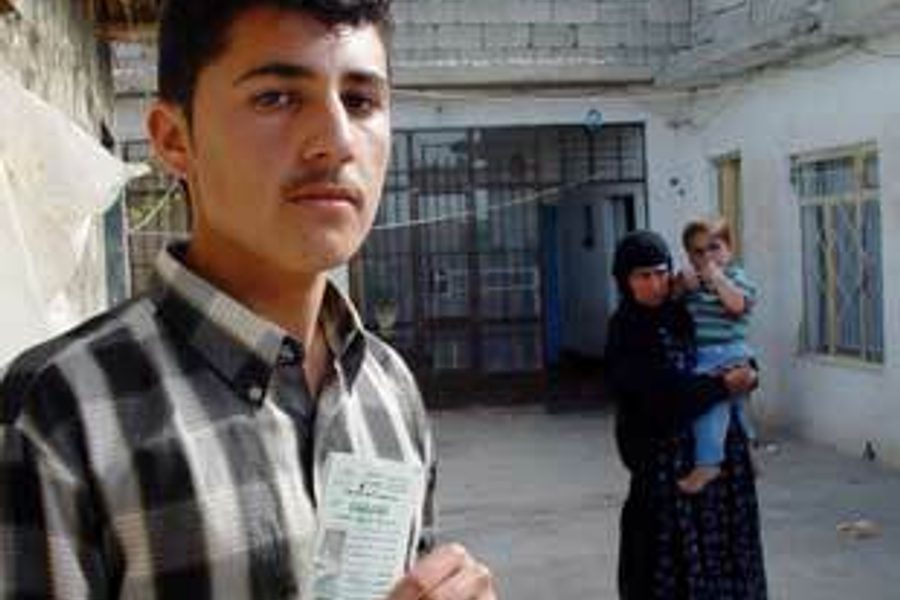

On a rainy March morning, in a drab office complex off one of Metro Detroit’s many expressways, I met Mona and Fadi Rabban.
In broken English, they greeted me graciously, keeping their heads slightly bowed. The diminutive Fadi was dressed in black jeans and a beat-up leather jacket. His beautiful middle-aged wife donned a thin, black cardigan and black slacks, which seemed less suitable for the Midwest winter.
Just six months earlier, the Rabbans had been in Jordan awaiting resettlement to the United States. Their arrival in America capped a journey that began in early 2006, when insurgents forced them to flee their Baghdad home.
Fadi, who was an accountant for 35 years, worked for a company that occasionally did business with American firms – which, in today’s Iraqi capital, is a dangerous venture. “When they send you a threat, you have to do [as they say], otherwise they will kill you,” he says. “They are serious about it, it’s not like a joke.”
In a war and occupation that has wrought innumerable, horrific consequences, the Iraqi refugee crisis is among the most disheartening. More than 4 million Iraqis – including the Rabbans – have been externally or internally displaced since the American invasion, and while their stories are ignored in much of the West, their forced migration constitutes a humanitarian and political crisis that has yet to be adequately addressed.
Iraqis flee
In the upcoming book War Without End: The Iraq Debacle in Context, Michael Schwartz, a sociologist at the State University of New York at Stony Brook, writes that Iraq has undergone three waves of displacement since the war began.
First, de-Baathification of the Iraqi government, the disbandment of the Iraqi military and the closing of state-owned industries in 2003 left hundreds of thousands of Iraqis with limited economic prospects. A kidnapping industry boomed shortly thereafter, forcing much of Iraq’s moneyed and political elite – many of whom were targeted for ransom – to flee.
The second wave came a year later, when American troops began invading insurgent strongholds in cities such as Fallujah and Samarra. Neighborhoods turned into battlegrounds, further disrupting the lives of residents uninvolved in the conflict.
Finally, beginning in 2005, and escalating over the next two years, ethnic cleansing in Baghdad and elsewhere displaced what Schwartz calls “a tsunami” of citizens – young and old, rich and poor. The infamous February 2006 bombing of Samarra’s Golden Dome, an honored Shiite shrine, accelerated the exodus. In all, the number of refugees is staggering, far outstripping the 900,000 Iraqis, primarily Kurds, who were internally displaced during former Iraqi President Saddam Hussein’s brutal regime.
While people of all ethnic sects have been affected, Chaldean Catholics – like the Rabbans – have borne a disproportionate burden. Though Chaldeans make up only 3 percent of Iraq’s population, conservative estimates suggest that 25 percent have fled to Syria or relocated to northern Iraq. Sunnis and Shiites have bombed Chaldean-owned businesses and Christian churches in Baghdad, Kirkuk and Mosul. And in one of the war’s most high-profile kidnappings, Chaldean archbishop Paulos Faraj Rahho was abducted on Feb. 29 and his body found two weeks later, half buried in a shallow grave in Mosul.
“Communities that are not protected by larger groups that have militias, like Christian communities, have been especially hit hard,” says Brian Katulis, a senior fellow at the Center for American Progress, whose work examines U.S. national security policy in the Middle East.
The Karanas are another such family. (Editor’s Note: The names of both families have been changed at their request. No other facts have been altered.) Although reticent during our interview, Samir and his wife Ikhlas stressed, “the situation over there was not safe.”
In 2005, Ikhlas was pregnant with their first son and Samir’s jewelry business was tanking. Like many of their countrymen, they decided to pack up and move to Syria for some needed stability.
But life in neighboring nations is far from comfortable. Countries of asylum, particularly Syria and Jordan, are feeling the strain from influxes of Iraqis – approximately 1.5 million to Syria and 700,000 to Jordan since the war began. International nongovernmental organizations (NGOs) report that hospitals are overcrowded, and the Brookings Institution found that apartment rental prices in the Syrian capital of Damascus have tripled since the war broke out.
To make matters worse, many NGOs have been forced to deliver refugee services in major cities (as opposed to rural settings), which is difficult. Because the population is not concentrated in designated camps, refugees are harder to identify and reach.
Jake Kurtzer, a congressional advocate for Refugees International, notes that without protective status or strong humanitarian community support, refugees face enormous obstacles. “The personal dynamics of running out of resources,” Kurtzer says, “have left Iraqis really in a very dire humanitarian situation.”
For the Rabbans and their two sons, now 18 and 24, a $200 per month apartment in Jordan became a financial burden when no one in the family could find work. The problems didn’t stop there.
“You’re not allowed to take your kids to school, you have no medical insurance,” Fadi says, “and they count you as an illegal resident, so if they catch you, they will throw you [back] over the border.”
It’s not much easier for the 2 million people who have relocated within Iraq’s borders. Many Iraqi refugees live in substandard or overcrowded shelters, only 22 percent report regular access to food rations, 14 percent have no access to healthcare, 33 percent cannot access the medications they require and 31 percent report that their property is occupied, according to a January report by the International Organization for Migration. And the crisis is deepening.
Bureaucratic purgatory
Not surprisingly, a growing number of Iraqis – many of whom are running out of savings and weary of conflict – have attempted to resettle outside of the Middle East entirely. For those seeking refuge in the United States, southeast Michigan has become a popular destination.
Jumana Salamey, curator of education at the Arab American National Museum in the Detroit suburb of Dearborn, says that Christians from Syria and Lebanon began immigrating to Detroit at the turn of the 20th century, looking to establish economic security abroad by selling textiles or working in the burgeoning auto industry.
Another wave of Muslim and Christian Arab immigrants arrived after World War II, some hoping to continue their educations and others lured by their well-established families. Wars and political tension in Lebanon, the Palestinian territories, and Iraq led a third generation of expatriates to Detroit in the ’70s, ’80s and ’90s.
Today, more than 150,00 Chaldean Americans and 300,000 Arab Americans call Metro Detroit home. For many, they considered this the Arab capital of the United States, home to Arab-owned businesses, mosques and the Arab American National Museum.
While in Jordan, the Rabbans had dreams of resettling in Detroit, both to join the vibrant Chaldean community and to reunite with their daughter, who had previously married and moved to the Detroit suburb of Farmington Hills. Gaining such a coveted resettlement allocation was a grueling process. Over a span of 18 months, the Rabbans were interviewed seven different times, first by representatives from the U.N. High Commissioner for Refugees (UNHCR), then by FBI agents.
“The interviews were very detailed and very hard,” Fadi says. “They were so serious, they were taking every single bit of information from us.” Field agents spared no details, verifying the consistency of their accounts, administering physical exams and running background checks. “You want to make sure all of the information is correct,” he says, “but because the situation is so hard in Jordan, you feel that you want to make [the process] shorter.”
The Karanas had a similar experience in Syria. Two years passed between the day they submitted their UNHCR application and their resettlement date in the Detroit suburb of Oak Park. They acknowledge they were lucky – only 10 percent of applicants who register for relocation qualify, according to the Christian Science Monitor – but that didn’t make their time in bureaucratic purgatory move any faster.
Motor City blues
When the families arrived in Michigan, they found a community willing to help them assimilate, a unique regional attribute.
“The community is established already,” says Rafat Ita, my translator and community resources coordinator for the Lutheran Social Services of Michigan (LSSM). “They walk in, they speak the language, and they feel like they are home.”
LSSM, a state-funded nonprofit agency, helps refugees from across the world obtain housing, food, transportation and employment. It also provides refugees with translation services, English as a Second Language classes and some financial assistance.
Ita, who resettled from Iraq in 1994, says LSSM’s support was critical to his successful immersion into American life. “It was a blessing when I came here and they took care of me, getting me transportation, finding me a job,” he says. “Without [LSSM], it definitely would have been very difficult.”
But what Detroit boasts in Middle Eastern culture, it lacks in economic opportunities. As Michigan sheds more and more manufacturing jobs – 300,000 since 1999 – its unemployment rate rises. In November 2007, that rate hit 7.4 percent, a full percentage point higher than any other state in the nation. Even worse, the Department of Treasury forecasts that unemployment will jump to 8.3 percent this year and 8.9 percent in 2009.
“It’s hard because the economy is so bad,” says Ita. “When they came in, there were no jobs, and the services [like food stamps and Medicaid] were … more difficult to get than they were 10 years ago.”
Since arriving in September, Fadi has failed to secure employment, although it’s not for lack of effort. He’d prefer to work in accounting, but his age and his cursory knowledge of English are major liabilities in the tight labor market, and he’s applied for entry-level work in a variety of fields. So far, he’s found no takers.
His eldest son, a former university student in Baghdad, landed a job working in the stock room at a department store. His mother and father were thrilled, but his bosses quickly cut his hours to 15 per week, meaning he nets only around $400 a month, the family’s sole income source.
The youngest son is adept with computers but has been turned down repeatedly for information technology jobs. As the months pass, his father says the 18-year-old, who has battled depression since leaving Iraq, spends more and more time holed up in his room.
Samir’s English is better than Fadi’s, but he has had just as much difficulty scoring work. Down the road, he would like to sell jewelry like he did in Baghdad, but he says that without a car, which he can’t afford, it’s difficult to connect with people in that industry. For now, he waits patiently with his wife and son at home, hoping something comes up.
Pitiful response
Despite their woes, both families seem resolutely optimistic and say they have no intention of returning to Iraq. And when friends and family update them about life in Baghdad, it puts Michigan’s shortfalls in perspective.
“Our family is still over there and it’s just such a dangerous life,” Samir says. “The main things we hear about are the services. There’s almost no water, electric [or] transportation.”
Mona says that when they fled, they left their home fully furnished. Insurgents have since moved in. “We can’t go back,” she says, “or we’d be killed.”
Given this context, the Bush administration’s response to the displacement crisis has been pitiful. From 2003 to 2007, the White House – which instigated the war and made scores of Iraqis vulnerable by employing them as translators and drivers – refused to acknowledge the existence of a crisis at all, resettling a mere 466 refugees into the United States.
Rising violence and growing attention to the emergency forced President Bush’s hand in early 2007. Secretary of State Condoleezza Rice created a high-level State Department task force on the refugee issue and promised to resettle 25,000 Iraqis. But over the course of the year, that target dropped to 7,000, and later to 2,000. By year’s end, only 1,608 Iraqis had been admitted.
The number of refugees processed each month would have to triple for the administration to meet its new 2008 goal of resettling 12,000 refugees. And on March 11, the State Department’s Senior Coordinator of Iraqi Refugee Issues James B. Foley told the House subcommittee on Middle East and South Asia that reaching that number is “not guaranteed.”
By contrast, Sweden, a nation of 9 million people, has resettled more than 90,000 Iraqis, in spite of its opposition to the invasion. The Center for American Progress’ Katulis and his colleagues have advocated that the United States should take in at least 100,000 refugees annually, based on UNHCR estimates of Iraqi citizens facing extreme vulnerability.
Why does America keep missing its targets? The State Department points to bureaucratic snafus, ranging from the Department of Homeland Security’s (DHS) stringent security review of each applicant, to jurisdictional confusion between the State Department and DHS, to a lack of interviewers in the field. Kurtzer says the fault lies with the White House, where officials refuse to take the problem seriously.
“There’s been a lack of political will from the senior levels of the administration to respond to this crisis in a way that we know the government is capable of responding,” he says. “When the White House is interested in putting resources and finding solutions to a problem, they are clearly capable of doing it.”
Such was the case in 1975, when, under President Gerald Ford, the United States resettled 130,000 South Vietnamese refugees between May and December after the fall of Saigon. Overall, more than 900,000 were eventually admitted to the country. “To do less,” Ford later said, “would have added moral shame to humiliation.”
Even the current administration has accepted expatriates when it has been politically viable. In May 2006, the White House agreed to move forward with the resettlement of thousands of Burmese refugees, a region that has garnered the attention of First Lady Laura Bush.
But Iraq is a different story.
Admitting that the embattled nation is in the throes of a humanitarian crisis disrupts the narrative that Iraq is stable and the war is winnable. Allowing people from the Arab world to emigrate freely could also brand the GOP as soft on terrorism, a political liability among the party’s conservative base, especially in an election year.
Unless the Congress and the president implement sweeping reforms immediately, the crisis will only worsen; Foley told the House subcommittee that the situation is intensifying and “the most critical problem is increasing impoverishment.”
What’s more, mass displacement could complicate Iraq’s national reconciliation, a process Gen. David Petraeus recently admitted is nowhere near complete. As Iraqis relocate permanently, shifting populations will, in part, determine how certain sects are compensated in a power-sharing deal.
“It’s not only a humanitarian issue, it’s a deeply political issue, too,” says Katulis. “This will necessarily be one component of that [process] that many people have not yet thought of.”
Back in Michigan, the refugees continue to put their lives back together. The Karanas are planning to enroll their son in day care soon, which will allow him to interact with kids his own age. The Rabbans have enjoyed spending time with their extended family, including their daughter.
“We want to build our future here, for ourselves and for our kids,” says Fadi. “We have nothing to build back home.”

I hope you found this article important. Before you leave, I want to ask you to consider supporting our work with a donation. In These Times needs readers like you to help sustain our mission. We don’t depend on—or want—corporate advertising or deep-pocketed billionaires to fund our journalism. We’re supported by you, the reader, so we can focus on covering the issues that matter most to the progressive movement without fear or compromise.
Our work isn’t hidden behind a paywall because of people like you who support our journalism. We want to keep it that way. If you value the work we do and the movements we cover, please consider donating to In These Times.