
PrintDiscuss
Culture » June 28, 2005

Torture Fatigue

By Silja J.A. Talvi

Tags   

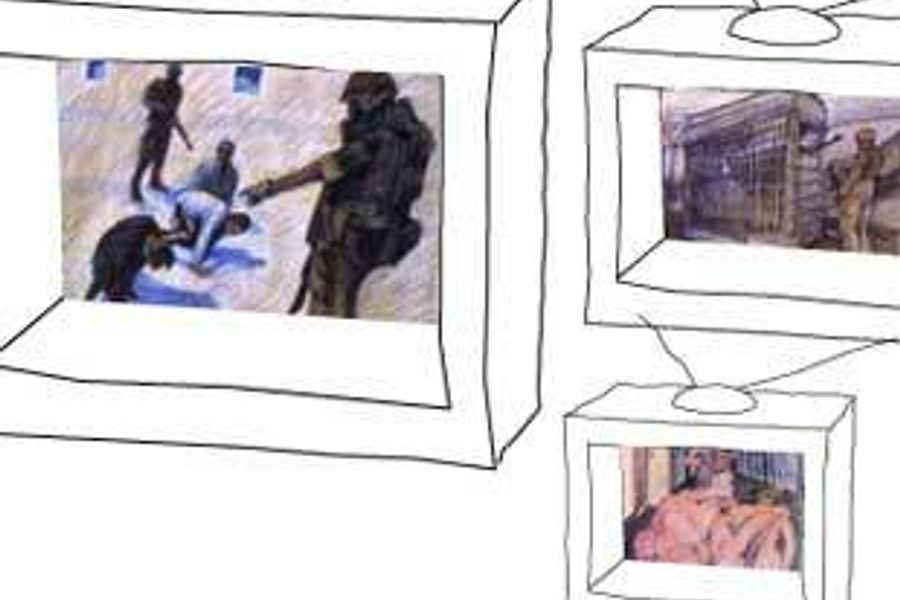
“The Christian in me says it’s wrong,” Army Specialist Charles A. Graner Jr. said of torturing prisoners in Abu Ghraib prison in Iraq. “But the corrections officer in me says I love to make a grown man piss himself.”

Photos taken of him demeaning captives at Abu Ghraib exposed Graner as the sadist that his surroundings allowed him to be. But are the differences between brutal correctional officers like Graner and other Americans as stark as we would like to think?

An acquaintance of mine recently admitted how much he enjoyed watching the torture scenes in the new blockbuster, Sin City. “I know it’s strange,” he said, “but there’s something I get out of seeing torture and violence like that on the screen. It’s like it’s some kind of release.”

He is not alone. Slate’s David Edelstein enthused that the film boasted “the most relentless display of torture and sadism I’ve encountered in a mainstream movie. My reaction to Sin City is easily stated. I loved it. Or, to put it another way, I loved it, I loved it, I loved it. I loved every gorgeous sick disgusting ravishing overbaked blood-spurting artificial frame of it. … It seems pointless to tut-tut over the depravity. Sin City is like a must-have coffee-table book for your interior torture chamber.”

That interior torture chamber is more visible in popular culture than ever before. One of the nation’s most popular network television shows, “24,” opened its season finale with an over-the-top torture scene of a man, forcibly strapped down to a chair, being shocked repeatedly with volts of electricity, screaming and crying out in sheer agony. The scene was so attention-grabbing that it ended up being featured as one of the week’s top events on VH1’s “Best Week Ever.” Torture pops up everywhere these days, even on the latest T-Mobile commercial, which features a young, black man tied down to a chair, screaming in an interrogation-style room as he’s tortured by having his phone bill run up. At the end of the commercial, a smiling Catherine Zeta-Jones delivers her pitch as he stumbles around the store, still bound to the chair.

What accounts for the prevalence and popularity of these scenes of torture and misery? Could these media images be serving as a form of misplaced cathartic release to ease our social conscience, a bizarre way of processing and desensitizing ourselves to real life torture?

Consider that only one-third of Americans questioned in a Washington Post-ABC News poll last May defined what happened at Abu Ghraib as “torture.” Half of those polled believed that such acts of brutality were taking place as a matter of policy in the “war on terrorism.”

Our legislators are no better in this regard. With the notable exception of individuals like Sen. Patrick Leahy (D-Vt.), congressional vows to find out who was responsible for the Abu Ghraib scandal ebbed after the prosecution of a few low-level ranking officers, a few fines and the issuance of a single demotion.

In an exhaustive May 2005 Amnesty International report, “Guantánamo and beyond: the continuing pursuit of unchecked executive power,” the running count of detentions in the global war on terror stands, at least, at 70,000 people, including the known deaths of 27 individuals in U.S. custody since 2002. To take but one example, consider this June 2004 account of Martin Mubanga, a British citizen who was kidnapped by U.S. Forces in Zambia and eventually brought to Guantánamo:

I needed the toilet and I asked the interrogator to let me go. But he just said “you’ll go when I say so.” I told him he had five minutes to get me to the toilet or I was going to go on the floor. He left the room. Finally, I squirmed across the floor and did it in the corner, trying to minimize the mess … He comes back with a mop and dips it in the pool of urine. Then he starts covering me with my own waste, like he’s using a big paint-brush, working methodically, beginning with my feet and ankles, and working his way up my legs. All the while, he’s racially abusing me, cussing me: “Oh, the poor little negro, the poor little nigger.” He seemed to think it was funny.

What such systemic brutality means, on some level, is that Americans bear collective responsibility for the damage our government has done. That’s not an easy thing to contemplate. But the public won’t find any such admission represented on the pages of our commercial newspapers and magazines. Instead we see outrage and compassion about things that we’re not responsible for, the deaths of Terri Schiavo and the Pope, for instance, or the toll of the tsunami.

At the recent National Conference for Media Reform, author Naomi Klein spoke of these media-managed, “ritualized, collective mourning moments” that serve as “compassion release valves.”

“We have moments where all that pent up compassion is allowed to release, and you are allowed to care [and have] spasms of outrage and compassion,” Klein said.

Such large-scale, media-frenzied, compassion-release-valve mechanisms are important, she added, because “the feeling of being outraged alone is the feeling of being crazy.”

Could it be that Americans are subconsciously trying to stay sane by desensitizing themselves and finding cathartic release in endless media depictions of torture and brutality? The U.S. military death toll now nears 2,000 men and women, in addition to the countless thousands of Iraqis and Afghanis who have died. Who among us truly wants to face the emotional impact of what we’ve done?

I asked clinical psychologist Bruce Levine, the author of Commonsense Rebellion, what he thought of all of this. “When you become disconnected from your own alienation [from society], you become cut off from your humanity,” he told me. “You become numb to all kinds of atrocities.”

A crucial mechanism of that numbing process where real-life torture is concerned seems to revolve around the ability to release primal reactions (terror, fear and outrage, for instance) in both a socially condoned and politically non-threatening way. Gorging on the barrage of fictionalized torture imagery has become the easiest and most accessible way for American citizens to do this with the least possible discomfort. Whether consciously or subconsciously, the writers and producers of torture-saturated media play a crucial role in this process, feeding and fueling this perverse and deeply rooted pathology.

These media-produced, sanitized bloodsports have become a thick bandage affixed over the deep and ugly gash of human suffering and cruelty. But that bandage can only stay in place for so long before it begins to rot away.

Real healing and emotional catharsis would actually require genuine discomfort, discourse and reparation. It would necessitate an admission of our collective culpability for the emotional and physical damage inflicted by our government, whether on the streets of Baghdad, or in the interrogation rooms of Abu Ghraib and Guantánamo Bay.

Without such reflection, we’re headed for our own true-to-life Sin City, a veritable carnival of bloodsport, torture and misery for all.


  • Help In These Times publish more articles like this. Donate today!
  • Subscribe today and save 46% off the newsstand price!
  • Or win a subscription to In These Times by taking this short survey!
Silja J.A. Talvi, a senior editor at In These Times, is an investigative journalist and essayist with credits in many dozens of newspapers and magazines nationwide, including The Nation, Salon, Santa Fe Reporter, Utne, and the Christian Science Monitor.

More information about Silja J.A. Talvi
Tags   
  • subscribe to print magazine

  • Reader Comments

    My feeling is that sadists are often attracted to power and positions of authority and many people who start off sane and compassionate become power-drunk after holding onto that power. 

    “Could these media images be serving as a form of misplaced cathartic release to ease our social conscience, a bizarre way of processing and desensitizing ourselves to real life torture?”

    Maybe.  Maybe those folks attracted to perverse entertainment are already desensitized.  Are these type of images more prevalent or are we more conscious of the reality of torture these days? 

    I think that torturers can inflict pain because they are numb to their own feelings.

    Our own gov’t is surely powerdrunk when they use torture for military gain, in secretive settings, and with no accountability for abuse.  It is an outrage that torture is even considered useful!

    Posted by pick of the litter on Jun 28, 2005 at 8:57 AM

    “The Christian in me says it’s wrong,” Army Specialist Charles A. Graner Jr. said of torturing prisoners in Abu Ghraib prison in Iraq. “But the corrections officer in me says I love to make a grown man piss himself.”

    The implicatin being that, but for his christianness, he would just be a torturer.  Somehow, I think most people would say it’s wrong without having to use their religion as a crutch to explain it.  In fact, I think most people would think it’s despicable, independent of any religious beliefs.

    Posted by Lefty on Jun 28, 2005 at 9:26 AM

    I think in some ways we’re desentized to it—such as in our entertainment.  Remember when Lucy & Ricardo had to sleep in different beds? Gradually we became desentized to these things.  Less is no longer more and more is no longer enough.

    However, when I think back to the witch hunts and the tortures that were performed on those accused of being witches, I have to wonder if this is a matter of simple desensitization.  In some ways the fear of terrorism is akin to the fear of witchcraft: you don’t know who is a witch, no one admits to it, you don’t know where it will strike.  Granted, witchcraft was a fallacy and terrorism is not, but the fears are similar. 

    Because of the unpredicatability of where terrorism will strike, and the feeling that you are safe nowhere, and that your neighbor could be a terrorist, and the helplessness that results, I think torture may be a release, an illusion we create to think we are doing something, to think we are defending ourselves, to think we are beating the enemy.

    Posted by Carolyn on Jun 28, 2005 at 9:43 AM

    If authority has not supervision, it has been shown that normal people find their darker side.

    From http://www.psychologymatters.org/spe.html

    “In 1971, a team of psychologists designed and executed an unusual experiment that used a mock prison setting, with college students role-playing prisoners and guards to test the power of the social situation to determine behavior. The research, known as the Stanford Prison Experiment, has become a classic demonstration of situational power to influence individual attitudes, values and behavior. So extreme, swift and unexpected were the transformations of character in many of the participants that this study—planned to last two-weeks—had to be terminated by the sixth day.”

    ” The major results of the study can be summarized as: many of the normal, healthy mock prisoners suffered such intense emotional stress reactions that they had to be released in a matter of days; most of the other prisoners acted like zombies totally obeying the demeaning orders of the guards; the distress of the prisoners was caused by their sense of powerlessness induced by the guards who began acting in cruel, dehumanizing and even sadistic ways. The study was terminated prematurely because it was getting out of control in the extent of degrading actions being perpetrated by the guards against the prisoners - all of whom had been normal, healthy, ordinary young college students less than a week before.”

    I remember this back in 1971 when it was reported. I have only seen one reference to it in the news, and that on the internet, since the torture scandals of Guantanamo and Iraq began. And this experiment was performed without the pressure for results that were on the guards in Iraq. It is not hard to imagine how that amplifies it.  This experiment is very well known within the field of psychology and prisons. The guilt is on the ones who do not supervise and control the guards.

    Posted by brock on Jun 28, 2005 at 9:56 AM

    We have reached 150 signatures on the Petition to support Sen. Durbin’s statement on the torture at Guantanamo Bay. But we need more before I can send it to Sen. Frist, the Majority Leader in the Senate. Please forward to everyone and post where ever appropriate.

    This is a defining moment in our current events. How are we as citizens responding to torture being done in our names and with our tax money? What will the people of the future say about the average American citizen of our day if we let these crimes against humanity go on.

    Even if you believe that all those being held in Guantanamo are guity of terrorist activities, even though there have never been charges brought against them nor a trial to determine guilt or innocence, you cannot deny them the rights that we as a nation signed onto, whether through the Geneva Convention, the Declaration of Human Rights or the international war crimes tribunals calling for the end to crimes against humanity. Perhaps you believe that those being held at Guantanamo Bay have no rights. Is that really what we have decended to in the name of security?

    Are we a nation of vengence or a nation of laws?

    As a resident of Illinios, a citizen of the U.S. and a member of Humanity, I support the statement made by Sen. Richard Durbin (D. IL) on the senate floor concerning prisoner abuse at Guantanamo bay.

    His words are being twisted by some in the media and on the other side of the aisle in the Senate. I urge you to please read his words for yourself at the link below and then if you agree with them please sign the petition at the other link that shows your support.

    Senator Durbin has always shown his support for the U.S. troops through his word and deeds, but now some want to portray him as a traitor and supporter of terrorists. Take the time to show those in the Senate majority that Senator Durbin represents the views of the majority of the people.


    http://talkleft.com/Gitmofloorstatement061405.pdf

    http://www.thepetitionsite.com/takeaction/641648866

    Posted by greg on Jun 28, 2005 at 10:13 AM
  • extended discussion >>>Continued...

    Discussions with more than 5 comments are continued on our special discussion page to encourage continuity and ease of use. There are currently 44 posts.

Appeared in the August 2010 Issue
IN THESE TIMES COMMUNITY MEMBERS